Don’t Ban Rough Buying, De Beers Urges

Bruce Cleaver

De Beers CEO Bruce Cleaver has called on the trade to allow rough purchases, assuring manufacturers the company won’t require them to buy in the weak market.

“We will only sell [rough] when the demand is such that it can create sustainable value for all of us,” the executive wrote in a blog post Friday. “However, just as we are not compelling our clients to purchase, we strongly believe it is counterproductive for any part of the industry to compel them not to purchase.”

Cleaver’s plea comes after the Gem & Jewellery Export Promotion Council (GJEPC) and other Indian trade organizations called on the nation’s diamond sector to pause rough-diamond imports for 30 days, beginning on May 15. The move would improve the Indian industry’s liquidity situation and deplete inflated polished inventories, the trade bodies explained.

Without explicitly referencing the Indian trade groups’ appeal to their members, Cleaver argued that supply had already been significantly reduced after De Beers suspended production at most of its mines. “Almost all other diamond producers have halted or significantly reduced supply, with some mines unlikely to return to production,” he added. De Beers cut its production guidance for 2020 to 25 million to 27 million carats, more than 20% below its initial projection, Cleaver noted.

The company also canceled its March sight and is offering 100% deferrals at sight 4, which begins Monday. Sightholders are likely to defer the vast majority of purchases to later in the year, as weak consumer demand and the shutdown of India’s cutting industry have diminished appetite for rough.

On Friday, India extended its nationwide lockdown by two weeks, raising the question of when diamond manufacturing would revert to normal, especially in the city of Surat, which produces more than 90% of the world’s polished goods.

Marketing message

Meanwhile, Cleaver urged the industry to capitalize on the diamond’s symbolism, as consumers will seek to purchase “fewer, but more meaningful things” as they move out of lockdown. Signs of pent-up demand from delayed weddings, and self-purchases to reward hardships that have been overcome, are starting to show in China as the lockdown there has eased, the CEO commented. People are visiting stores and shopping malls again, he said.

In its communication with consumers over the coming months, De Beers will emphasize the role diamonds play in shaping a better world and in forging meaningful connections, he stressed.

“Just as they have had to find innovative ways to stay connected with loved ones, we will find new ways to connect with them,” he said.

“Throughout time, the diamond has served as a powerful symbol of connection and meaning,” he wrote. “It has always been attached to life’s most precious moments and relationships and represented a store of value, but increasingly we believe a diamond is becoming a store of values.”

Source: Diamonds.net

De Beers Makes Dramatic Cut to Production Plan

De Beers Production

De Beers has reduced its full-year production guidance by 7 million carats, putting the miner on course for its lowest output since 2009. 

The miner expects to produce between 25 million and 27 million carats in 2020, compared to the 32 million to 34 million in its original projection, it said Thursday. The revised forecast for 2020 was due to the impact of the COVID-19 pandemic on mining activity and consumer traffic in key markets, the miner noted.

Rough-diamond production for the first quarter of 2020 slipped 1% to 7.8 million carats, roughly in line with the previous year. However, the coronavirus shutdown measures were not implemented at the miner’s sites until the end of the period, and had a limited impact on output, De Beers said.

Sales volume rose 19% to 8.9 million carats for the three months ending March 31. The increase was due to a favorable comparison with the same period the previous year, when demand was weak due to an oversupply of polished stones in the manufacturing sector. Additionally, the decline in demand caused by the pandemic — during which De Beers allowed customers to defer some of their allocations to the second quarter — was offset by higher appetite for lower-value goods, the company noted.

Production in Botswana declined 5% to 5.6 million carats, with diamond recovery at De Beers’ Orapa mine falling 7% as result of challenges in commissioning new plant infrastructure. Output at Jwaneng slipped 4% due to a planned shift to lower-grade ore.

Production in Namibia grew 6% to 511,000 carats, and in South Africa jumped 97% to 751,000 carats, as the final ore from the company’s open-pit operations at Venetia was mined prior to the transition to underground.

Output in Canada slid 19% to 844,000 carats, primarily due to the closure of the Victor mine, which reached its end of life in the second quarter of 2019. Output from Gahcho Kué, which the company owns in partnership with Mountain Province, rose 4% to 844,000 carats.

The first quarter featured two sales cycles, with proceeds falling 9% to $906 million. Demand reached a near-yearlong high in January, but fell again in February as the coronavirus began to spread. The company was forced to cancel its third site, which was due to begin at the end of March.

In 2009, the company slashed production by 49% to 24.6 million carats for the year when the global economic slowdown hit diamond demand. 

Source: Diamonds.net

De Beers Reveals Overhaul of Sight System

Measuring a rough diamond

De Beers plans to split sightholders into three categories and offer each group a more bespoke selection of rough diamonds as part of changes to its sales system.

Manufacturers, dealers and retailers will sign specific supply contracts designed for the “broad needs” of each business model, a De Beers spokesperson told Rapaport News Thursday.

The arrangement will take effect in January 2021, following the end of the current sightholder contract, which runs until December 2020. Applications start this week, giving companies four weeks to complete the process, a source in the rough market said on condition of anonymity.

The manufacturer contract will “support the core strengths” of each cutting firm, De Beers explained. Dealers — those that buy rough for resale — will receive a “regular and consistent range of goods,” especially in higher-volume areas. The retailer contract is tailored for companies that sell jewelry to consumers and also have polishing operations. Beneficiation contracts — for sightholders that commit to polishing certain goods in the country where they were mined — will remain as modified versions of the manufacturing contract.

“It is our ambition to offer supplies and services that can help to better support the unique strengths of the great businesses of the diamond midstream, and we feel this approach is the optimal way of achieving this,” the spokesperson said.

The company has long been contemplating changes to its sightholder system amid difficult conditions in the manufacturing and trading sectors, such as tight liquidity and an inventory imbalance. Its supply rules — based on a method known as “demonstrated demand” — have also faced criticism.

Under that system, De Beers mainly determines clients’ rough supply using their purchasing record — a controversial policy because it can encourage sightholders to take on unprofitable inventory to secure future access to its goods. It offers the diamonds in prearranged boxes that customers either take or leave, with only limited flexibility to adjust the contents. That sometimes forces sightholders to buy items they don’t want just so they can get the stones they need.

The current method has come under particular scrutiny given the excess polished in the market last year, which contributed to a slump in rough demand. Last July, Dutch bank ABN Amro urged its clients to stop buying unprofitable rough, and attacked the practice of making purchases purely to maintain supply allocations.

De Beers’ revenue fell 24% to $4.61 billion in 2019, while underlying earnings slid 87% to $45 million, as the supply glut left sightholders unwilling to buy more rough. The situation forced the miner to allow unprecedented refusals and other concessions to avoid flooding the market with goods.

The “need for us to adapt to the changing world” has been the subject of talks between De Beers and sightholders for a while, the company spokesperson added.

“This new approach to sightholder contracts is one way we are going about this,” he noted.

Source: Diamonds.net

Forevermark Unveils New Concept Store in China

De Beers Forevermark China

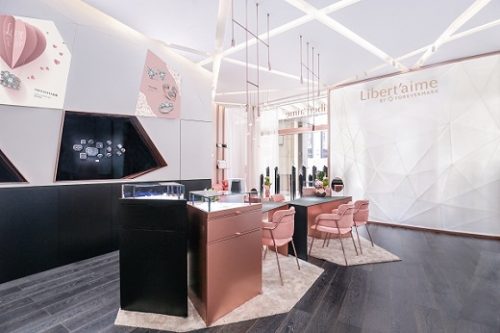
Forevermark has launched a concept store in Shanghai tailored to millennial shopping habits, marking its 1,000th branch in China.

The opening of the store, named Libert’aime, also celebrates the brand’s 10th anniversary of entering the country. The De Beers-owned brand designed the branch’s diamond-jewelry line with a young, self-purchasing consumer in mind, it said Tuesday.

The store combines online and offline platforms, including a WeChat store. It also features digital experiences such as a 3D diamond wall, and a “magic mirror” that allows customers to share pieces with friends and family.

The store includes sections dedicated to different product types. The “diamond bar” will feature daily-wear diamond jewelry, while fancy-cut and multi-diamond pieces will be located in the “spectacular diamond” area.

“[Libert’aime] brings together an innovative in-store offering with online and social channels to provide customers with a highly engaging and personalized buying experience,” Forevermark CEO Stephen Lussier said. “We recognize that our consumer continues to evolve and, with Libert’aime by Forevermark, we are thrilled to be offering a diamond-jewelry range that has been designed with a younger, more fashion-forward consumer in mind, who might just be starting their diamond journey.”

The Shanghai store will also feature a new collection, LE LIGHT, designed by popular Chinese actor and musician Timmy Xu Weizhou.

In addition, De Beers Diamond Jewellers has opened a new store in the luxury SKP shopping mall in Xi’an, its sixth in mainland China. The new branch will feature three separate divisions: one for bridal jewelry, a second with collections such as the Talisman, Enchanted Lotus and Dewdrop lines, and a third showcasing high-jewelry pieces.

Source: diamonds.net
Credit: Matt Crabb/De Beers