
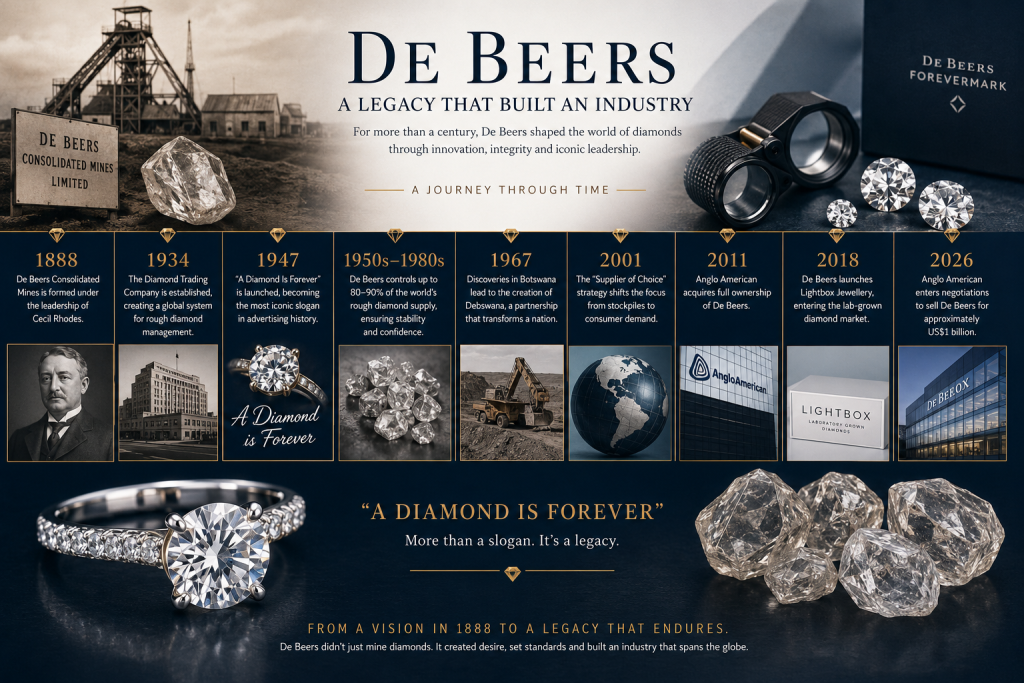
For more than a century, De Beers was the undisputed leader of the global diamond industry. It transformed diamonds from a relatively rare luxury into the world’s most desired gemstone, creating the modern diamond market through visionary marketing, strict supply management and consumer confidence.
Today, that same company may be sold for as little as US$1 billion, marking one of the most remarkable reversals in the history of the luxury goods industry.
Anglo American Nears Historic Sale
Mining giant Anglo American is reportedly close to selling De Beers as it continues its restructuring following the failed takeover attempt by BHP in 2024.
According to reports, the preferred bidder is the Global Diamond Consortium (GDC), led by former De Beers Chief Executive Gareth Penny and backed by the governments of Namibia and Angola.
The proposed agreement would see GDC pay approximately US$750 million upfront, followed by a further US$250 million at a later stage. Additional performance-based payments may also form part of the final transaction, although negotiations remain ongoing and no final agreement has yet been reached.
The consortium also intends to inject approximately US$500 million into De Beers following the acquisition to strengthen operations and refocus the company on the mining and marketing of natural diamonds.
A Dramatic Fall in Valuation
The potential sale price is extraordinary considering De Beers’ former worth.
When Anglo American acquired the Oppenheimer family’s remaining stake in 2011, the transaction valued De Beers at nearly US$13 billion. During its strongest years, analysts estimated the company’s value exceeded US$18 billion.
However, a combination of falling rough diamond prices, weak Chinese luxury demand, changing consumer spending and the rapid emergence of laboratory-grown diamonds has dramatically reduced profitability across the sector.
Anglo has written down the value of De Beers three times in just three years, reducing its book value to approximately US$2.3 billion earlier this year.
The Company That Built the Modern Diamond Industry
While today’s headlines focus on declining valuations, they should not overshadow De Beers’ extraordinary contribution to the global diamond trade.
Few companies have influenced an entire industry as profoundly.
Throughout most of the twentieth century, De Beers controlled the overwhelming majority of the world’s rough diamond supply. Through the Central Selling Organisation (CSO), it managed production, stabilised prices and created confidence that diamonds would retain their value.
Perhaps even more influential was its marketing.
In 1947, De Beers launched the now legendary slogan:
“A Diamond Is Forever.”
That simple phrase fundamentally changed consumer behaviour.
It established the diamond engagement ring as the global symbol of love and commitment and remains one of the most successful advertising campaigns ever created.
For decades, De Beers also invested heavily in consumer education, retailer training, grading standards and worldwide promotional campaigns that helped grow demand across Europe, North America, Japan and later China.
Without De Beers, the global diamond jewellery market as we know it today would likely never have existed.
Botswana Remains Central
Any transaction must also satisfy the Government of Botswana, which owns 15% of De Beers and jointly owns Debswana, the partnership responsible for producing most of Botswana’s diamonds.
President Duma Boko has previously expressed interest in increasing Botswana’s ownership of De Beers, although recent reports suggest the country may instead accept a larger minority stake.
Botswana remains one of the world’s most important diamond-producing nations, and its future relationship with De Beers will be crucial to any successful acquisition.
Gareth Penny Returns
Leading the proposed acquisition is Gareth Penny, who served as Chief Executive of De Beers between 2006 and 2010.
During the Global Financial Crisis, Penny successfully guided the company through one of the most difficult periods in diamond history by temporarily suspending mining operations, reducing supply and securing approximately US$1 billion through a rights offering.
His return signals an intention to restore De Beers’ focus on natural diamonds while adapting to today’s very different market conditions.
Milestones in De Beers History
1888 – Cecil Rhodes consolidates South African diamond mining companies to form De Beers Consolidated Mines.
1934 – The Diamond Trading Company is established, laying the foundations for centralised rough diamond distribution.
1947 – The iconic slogan “A Diamond Is Forever” is created by advertising agency N.W. Ayer, forever changing the jewellery industry.
1950s–1980s – De Beers controls as much as 80–90% of the world’s rough diamond supply, creating unprecedented market stability.
1967 – Major discoveries in Botswana eventually lead to the formation of Debswana, transforming Botswana into one of Africa’s greatest economic success stories.
1990s – Increasing production outside the De Beers system begins reducing the company’s market dominance.
2001 – De Beers introduces its “Supplier of Choice” strategy, shifting from stockpiling diamonds to demand-driven marketing.
2011 – Anglo American acquires full ownership of De Beers after purchasing the Oppenheimer family’s stake.
2018 – De Beers launches Lightbox Jewellery to enter the laboratory-grown diamond market, recognising changing consumer trends.
2025 – Lightbox is wound down as De Beers recommits its strategy to natural diamonds.
2026 – Anglo American enters negotiations to sell De Beers for approximately US$1 billion.
A New Beginning Rather Than the End
Although the proposed valuation represents a dramatic decline from De Beers’ former glory, the company still possesses some of the world’s most recognised diamond brands, valuable mining assets and decades of expertise.
More importantly, De Beers leaves behind a legacy that reshaped the global jewellery industry. It pioneered diamond marketing, built international confidence in natural diamonds and helped establish universal grading standards that continue to underpin the modern trade.
The challenge for new ownership will not be rebuilding history—but adapting that remarkable legacy to a new generation of consumers in a market where natural diamonds must increasingly differentiate themselves through rarity, provenance and enduring value.
Comments are closed