
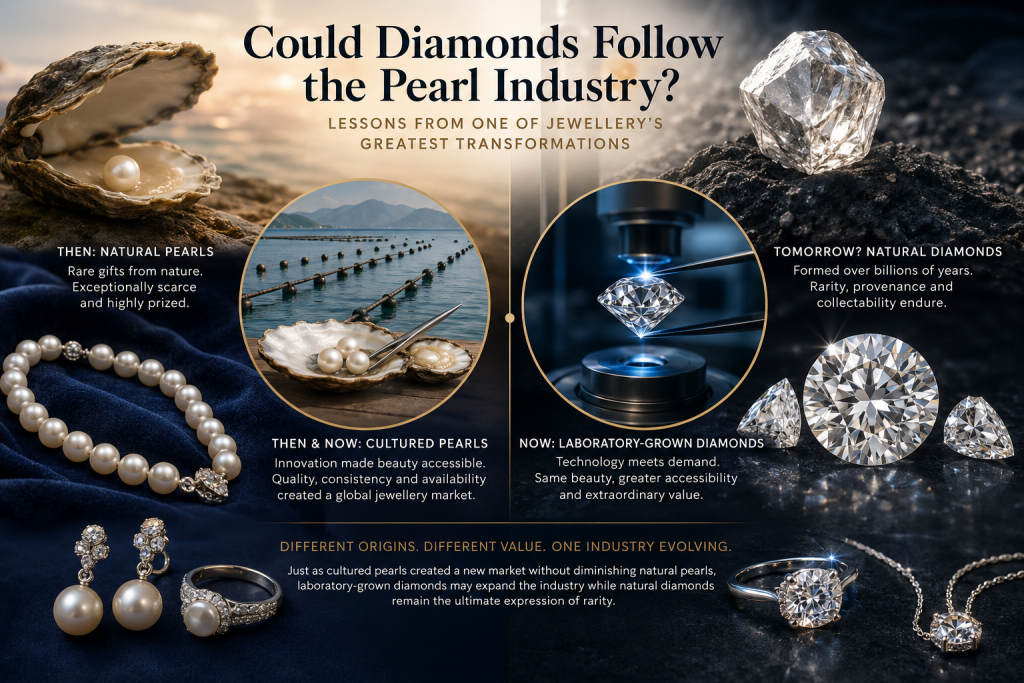
For more than a century, natural diamonds have represented rarity, permanence and prestige. Yet today, the diamond industry is experiencing one of the most significant periods of change in its history. The rapid rise of laboratory-grown diamonds has challenged long-held assumptions about rarity, value and production.
While many compare laboratory-grown diamonds to synthetic gemstones, perhaps a more relevant comparison lies elsewhere. The transformation of the pearl industry offers an intriguing historical precedent.
Could diamonds be following a similar path?
When Nature Could No Longer Meet Demand
Before the early twentieth century, every pearl was natural.
Finding a single fine pearl required divers to open thousands of wild oysters, making exceptional pearls extraordinarily rare and valuable. As demand increased, natural oyster beds became depleted through over-harvesting, pollution and environmental change. The jewellery market faced an obvious problem: consumers wanted pearls, but nature simply could not supply them in sufficient quantity.
The solution came through cultured pearls.
By introducing a tiny nucleus into a living oyster, pearl farmers could encourage the oyster to produce a genuine pearl under controlled conditions. The process still relied on nature, but it dramatically increased consistency, availability and affordability.
Initially, cultured pearls were met with scepticism. Many believed they would destroy the value of natural pearls.
Instead, something quite different happened.
Two Markets Emerged
Rather than replacing natural pearls entirely, cultured pearls created an entirely new market.
Millions of consumers who had never been able to afford fine pearls suddenly could.
Natural pearls, however, became even rarer. As natural harvesting declined, truly exceptional natural pearls became increasingly desirable to collectors, museums and high-end jewellery houses.
Today, important natural pearl necklaces regularly achieve extraordinary auction results because of their rarity and historical significance.
The market effectively separated into two distinct categories:
- Cultured pearls became the mainstream jewellery product.
- Natural pearls became exceptional collector’s items.
Both markets survived—but they served different customers.
Diamonds May Be Facing a Similar Evolution
Laboratory-grown diamonds are not imitation diamonds.
They possess the same crystal structure, chemical composition and optical properties as natural diamonds. Modern technology can produce exceptionally high-quality stones in a matter of weeks rather than over billions of years beneath the Earth’s surface.
Production efficiencies continue to improve.
Prices have fallen dramatically.
Quality has become increasingly consistent.
For many jewellery buyers, laboratory-grown diamonds offer larger sizes and higher specifications at significantly lower prices than natural diamonds.
This has fundamentally changed the entry-level diamond jewellery market.
The Difference is Rarity
Where the comparison becomes interesting is the concept of rarity.
Natural diamonds are finite geological creations formed over billions of years under immense heat and pressure.
Laboratory-grown diamonds can be manufactured repeatedly whenever production facilities are expanded.
This distinction mirrors the difference between natural and cultured pearls.
One derives its rarity from nature.
The other derives its availability from technology.
Neither is inherently “better” in every situation they simply satisfy different consumer priorities.
Luxury Has Always Valued Scarcity
History shows that luxury markets rarely disappear simply because a more affordable alternative becomes available.
Mechanical watches continue to thrive despite the accuracy of digital watches.
Original artworks remain valuable despite the existence of perfect reproductions.
Vintage wines command remarkable prices despite modern winemaking techniques.
Natural pearls retained their prestige after cultured pearls became mainstream.
Collectors often place a premium on objects that cannot simply be reproduced.
The same principle may continue to apply to exceptional natural diamonds.
Large, rare coloured diamonds, historically significant gemstones and stones with remarkable provenance are unlikely to lose their appeal simply because laboratory-grown diamonds become increasingly common.
Will Natural Diamonds Become More Exclusive?
As mining becomes more challenging and fewer new diamond deposits are discovered, the supply of natural diamonds may gradually tighten.
Several major mines are approaching the end of their productive lives, while fewer world-class discoveries have been made over the past two decades.
If production continues to decline while the finest stones remain desirable, natural diamonds could increasingly occupy a position similar to that of natural pearls—less common, more exclusive and primarily sought by collectors and connoisseurs.
Rather than competing directly with laboratory-grown diamonds, they may simply occupy a different market.
What Happens to Everyday Diamond Jewellery?
This may be where laboratory-grown diamonds reshape the industry most dramatically.
Consumers purchasing jewellery primarily for its appearance, design or sentimental value may increasingly choose laboratory-grown diamonds because they provide greater size and quality within a given budget.
Jewellery designers gain greater creative freedom.
Consumers gain more choice.
The overall market for diamond jewellery could even expand as affordability improves.
This is remarkably similar to what occurred with cultured pearls, which transformed pearls from an occasional luxury into an everyday jewellery category.
The Importance of Transparency
One lesson from the pearl industry is particularly relevant.
Consumers accepted cultured pearls because the industry clearly distinguished them from natural pearls.
Each category developed its own identity.
The same principle is essential for diamonds.
Natural and laboratory-grown diamonds are both genuine diamonds, but they have different origins, different rarity profiles and different market dynamics.
Clear disclosure, accurate grading and transparent terminology allow consumers to make informed purchasing decisions based on their own priorities rather than confusion or marketing.
The Future May Not Be Either-Or
The history of jewellery suggests that technological innovation rarely eliminates natural luxury products.
Instead, it often creates broader markets with distinct categories serving different needs.
Natural pearls and cultured pearls now coexist successfully.
It is entirely possible that natural and laboratory-grown diamonds will do the same.
Natural diamonds may increasingly represent geological rarity, heritage and long-term collectability.
Laboratory-grown diamonds may continue to dominate fashion jewellery, bridal markets and value-conscious consumers seeking exceptional visual beauty.
Rather than one replacing the other, both could become permanent parts of the modern jewellery landscape.
Conclusion
The transformation of the pearl industry demonstrates that innovation does not necessarily diminish the value of natural treasures. Instead, it can redefine their place within the luxury market.
Whether diamonds ultimately follow the same path remains to be seen, but the parallels are compelling. Laboratory-grown diamonds have undoubtedly changed accessibility and affordability, much as cultured pearls did generations ago.
History suggests that when technology makes luxury more accessible, the rarest natural examples often become even more distinctive.
For the jewellery industry, the future may not be about choosing between natural and laboratory-grown diamonds. Instead, it may be about recognising that each serves a different purpose, a different customer and a different definition of value.
As with pearls, the industry may simply be witnessing the emergence of two complementary markets one built on the rarity of nature, the other on the possibilities of technology.
Comments are closed