
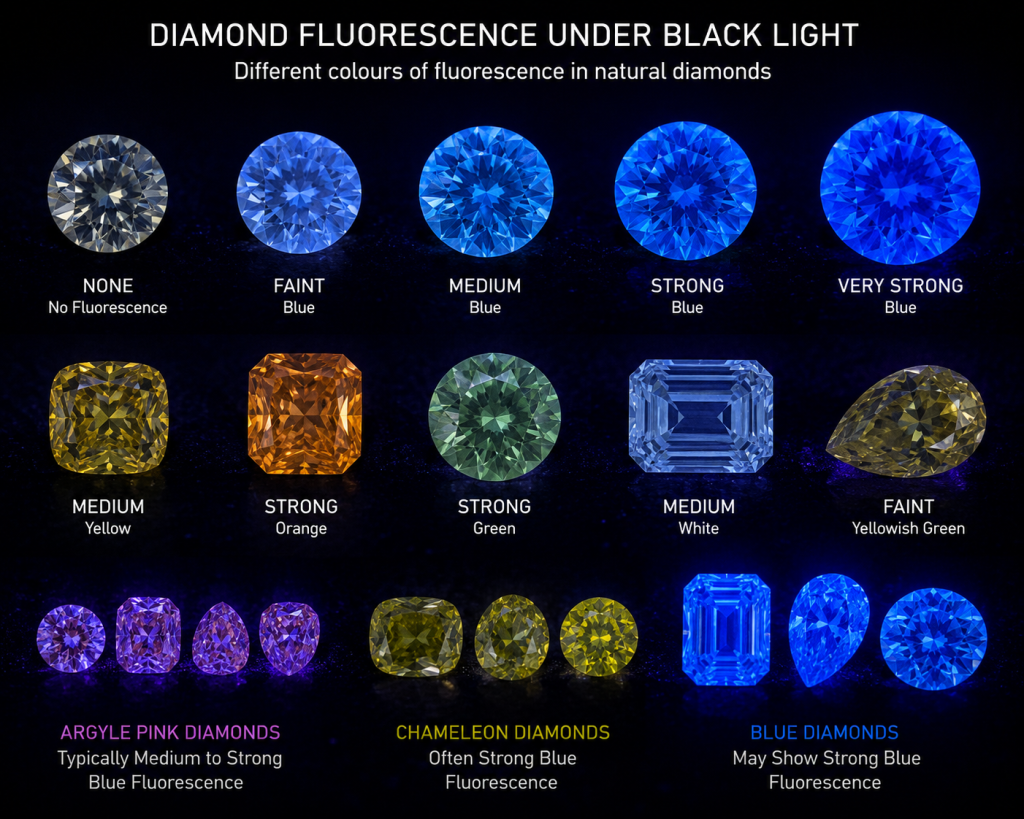
When people admire a diamond, they usually focus on the famous Four Cs carat, colour, clarity and cut. Yet one fascinating characteristic often overlooked by consumers is fluorescence. Far from being a flaw, fluorescence is a natural optical phenomenon that, in many diamonds, enhances their appearance and contributes to their individuality.
For gemmologists, fluorescence provides another layer of information about a diamond’s identity. For collectors and jewellery lovers, it can add an entirely different dimension of beauty particularly in rare coloured diamonds.
What is Diamond Fluorescence?
Fluorescence occurs when a diamond is exposed to ultraviolet (UV) light. Invisible ultraviolet rays excite trace structural defects within the diamond crystal, causing it to emit visible light. Once the UV source is removed, the glow disappears almost instantly.
Approximately 25–35% of natural diamonds exhibit some degree of fluorescence, while only around 10% display fluorescence strong enough to be easily observed.
The overwhelming majority fluoresce blue, although yellow, orange, white and even green fluorescence can occasionally occur.
This phenomenon has fascinated gemmologists for over a century and remains an important grading characteristic documented by leading laboratories such as the DCLA, GIA and other internationally recognised laboratories.
Nature’s Hidden Signature
Fluorescence is not an artificial treatment or enhancement. It is a natural characteristic formed deep within the Earth millions or even billions of years ago during a diamond’s crystallisation.
Different trace elements and atomic irregularities create different reactions to ultraviolet light, making fluorescence something of a natural fingerprint for each diamond.
In many cases, fluorescence remains completely invisible during everyday wear, only revealing itself under sunlight rich in ultraviolet radiation or beneath UV lamps.
The Blue Glow of White Diamonds
One of the most beneficial effects of fluorescence is seen in Cape-series white diamonds, particularly those in the H through M colour grades.
These diamonds contain a slight yellow body colour. Since blue is complementary to yellow on the colour spectrum, blue fluorescence can visually neutralise a portion of that warmth when the diamond is viewed in daylight.
The result is that many fluorescent diamonds appear:
- Whiter
- Brighter
- Fresher
- Slightly higher in colour than their laboratory grade may suggest
This effect is especially noticeable in outdoor lighting, where natural ultraviolet light is abundant.
For decades, experienced jewellers have recognised that a well-cut H, I, J or K colour diamond with medium blue fluorescence can face up remarkably white while offering excellent value compared with higher colour grades.
Only in a very small percentage of diamonds with very strong fluorescence can an undesirable oily or hazy appearance occur. Extensive studies have shown this affects only a minority of fluorescent diamonds, meaning fluorescence should be judged on the individual stone rather than by reputation alone.
Fluorescence and Fancy Coloured Diamonds
While fluorescence can improve the appearance of white diamonds, it becomes even more intriguing in the world of fancy coloured diamonds.
Here, fluorescence often contributes to the personality and visual excitement of the stone.
The Legendary Argyle Pink Diamonds
Among the world’s most treasured gemstones are the famous Argyle Pink Diamonds from Western Australia.
Many of these extraordinary diamonds display medium to strong blue fluorescence despite possessing vivid pink body colour.
The blue fluorescence creates a remarkable contrast with the diamond’s natural pink hue. Under ultraviolet-rich lighting, the diamond can appear even more vibrant and alive, adding another dimension to its already exceptional beauty.
Researchers have long associated the fluorescence in Argyle diamonds with the unique geological conditions that produced their distinctive pink colour—conditions unlike those found in almost any other diamond deposit on Earth.
Rather than detracting from their value, fluorescence has become part of the fascinating character that collectors admire in these exceptionally rare gems.
The Magical Chameleon Diamond
Perhaps no diamond demonstrates the beauty of fluorescence more dramatically than the Chameleon Diamond.
These exceptionally rare diamonds possess the remarkable ability to temporarily change colour.
Normally appearing olive green, grey-green or yellowish-green, they can shift to warmer yellow tones after gentle heating or following prolonged storage in darkness.
Many Chameleon diamonds also exhibit an intense and often spectacular fluorescence under ultraviolet light.
This interaction between colour change and fluorescence creates one of the most captivating visual displays found in any gemstone.
Scientists continue to study the exact atomic mechanisms responsible for this behaviour, making Chameleon diamonds one of gemmology’s enduring mysteries.
Fluorescence Adds Personality
Every fluorescent diamond possesses its own unique response to ultraviolet light.
Some emit a soft blue glow.
Others display a vibrant electric blue.
Rare stones may fluoresce yellow, orange or even white.
For collectors, this individuality makes fluorescence another characteristic that distinguishes one diamond from another. It reminds us that no two natural diamonds are truly identical.
Understanding Fluorescence in Jewellery
When selecting a diamond, fluorescence should never be viewed in isolation.
Instead, it should be considered alongside:
- Cut quality
- Overall transparency
- Colour
- Clarity
- Optical performance
A beautifully cut fluorescent diamond may appear more lively than a non-fluorescent equivalent, particularly in natural daylight.
In coloured diamonds, fluorescence often enhances the stone’s uniqueness and visual appeal, becoming part of its identity rather than a grading curiosity.
A Feature Worth Appreciating
For many years, fluorescence was misunderstood and sometimes unfairly discounted in the marketplace. Modern research and decades of gemmological observation have demonstrated that this perception is overly simplistic.
In many diamonds particularly those in the H to M colour range blue fluorescence can improve the apparent face-up colour. In rare fancy coloured diamonds such as Argyle Pinks and Chameleon diamonds, fluorescence contributes to the extraordinary visual characteristics that make these gems so highly prized.
Like fingerprints, inclusions and crystal growth patterns, fluorescence tells part of the story of a diamond’s geological journey.
It is one more reminder that natural diamonds are products of nature, each possessing characteristics that cannot be duplicated exactly.
Understanding fluorescence allows consumers to appreciate diamonds not simply for their colour or clarity, but for the remarkable optical phenomena hidden within them revealed only when nature shines a different kind of light.
Comments are closed