
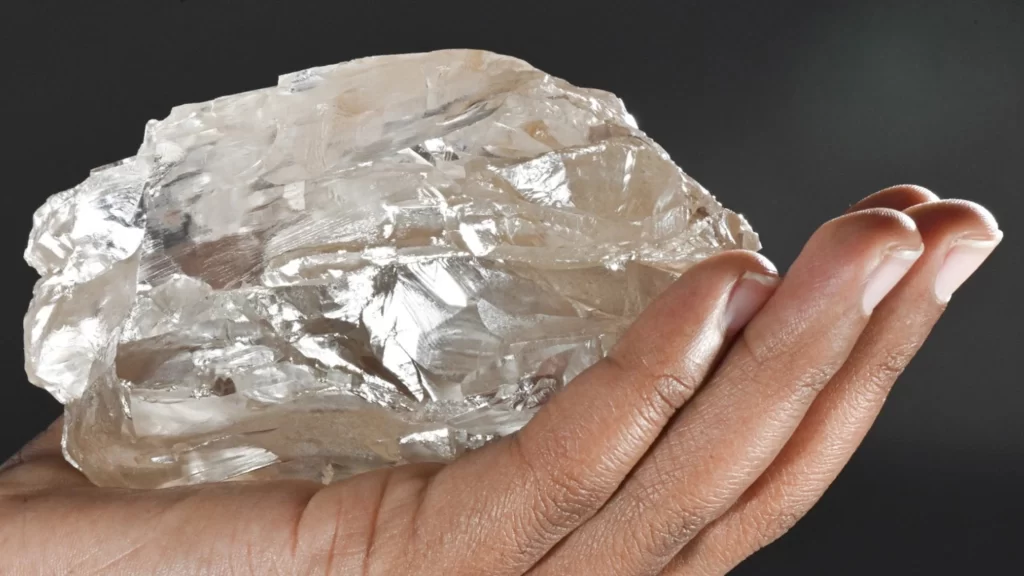
Botswana has warned that a growing diamond oversupply is set to weigh heavily on economic growth, as weak global prices and intensifying competition from lab-grown stones continue to suppress demand.
The world’s second-largest diamond producer after Russia is currently holding nearly double its permitted diamond stockpile, highlighting the severity of the downturn in the natural diamond market. Diamonds account for approximately one-third of Botswana’s GDP, making the sector critical to national economic stability.
According to the finance ministry’s 2026/27 Budget Strategy Paper published on Tuesday, Botswana held around 12 million carats of rough diamonds at the end of December, significantly above the government’s 6.5 million-carat ceiling.
“This suggests that, over the short term, production is expected to remain broadly unchanged until inventory levels are drawn down closer to minimum allowable thresholds, creating room for additional output,” the ministry said.
The prolonged slump has been exacerbated by weaker demand in the United States and China — the world’s two largest diamond markets — where retailers have scaled back orders amid growing consumer preference for lower-priced lab-grown diamonds.
Trade pressures are also adding to market strain. A 15 percent US tariff on diamonds, along with higher duties in key trading hubs such as India, is expected to prolong price weakness and further compress margins. The finance ministry described these developments as a “source of concern”.
Rough diamond prices are forecast to average $99.3 per carat, sharply lower than $128.8 in 2024. The ministry warned that any further decline during the current financial year could significantly reduce mineral revenues below current projections.
Mineral revenues are expected to fall to 10.3 billion pula ($770 million) in 2025/26, well below the long-term average of 25.3 billion pula. The shortfall, officials cautioned, is likely to persist over the medium to long term, with the possibility of a permanent structural decline.
The policy paper also warned that the extended weakness in the global diamond market “poses a significant threat” to economic growth. Botswana’s economy is forecast to contract by nearly 1 percent in 2025, following a 3 percent decline the previous year.
“Compounding this situation is the decline in foreign reserves and government savings, which is further constraining fiscal space and limiting exchange-rate policy options,” the ministry said.
Once among the poorest nations in the world, Botswana was transformed economically following the discovery of diamonds in the 1960s. Today, it is one of several African governments and businesses seeking a greater stake in De Beers, the world’s leading diamond producer.
Mining giant Anglo American has announced plans to divest from De Beers as the industry grapples with a prolonged downturn and structural shifts in global diamond demand.
Comments are closed