
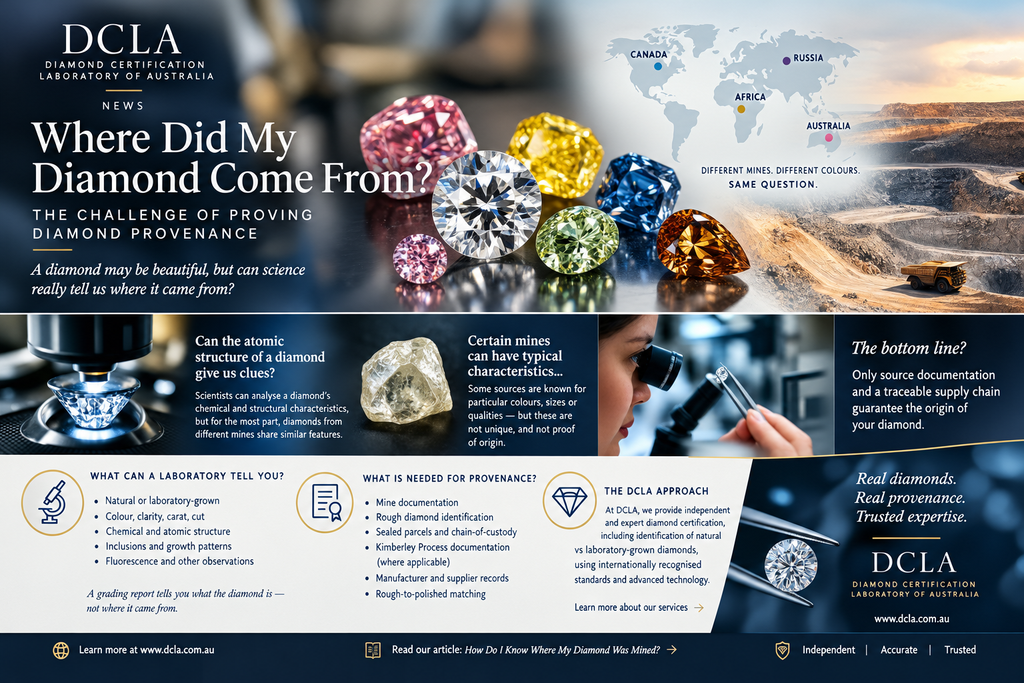
How can you prove the provenance of a polished diamond?
When buying a natural diamond, one question is becoming increasingly important:
Where did it come from?
A diamond may have been mined in Botswana, South Africa, Canada, Australia, Angola, Namibia, Lesotho, Russia or one of the many other diamond-producing regions around the world. But once that rough diamond has been cut and polished, can a laboratory actually look at the finished stone and determine which mine it came from?
For the vast majority of polished diamonds, the answer is no.
This is an important distinction between identifying what a diamond is and identifying where it came from.
A gemmological laboratory can examine a polished diamond and determine many things about it, including its natural or laboratory-grown origin, colour, clarity, carat weight and other characteristics. But determining the geographic origin of a natural diamond is a very different scientific problem.
DCLA has previously addressed the difficulty of determining where a diamond was mined and the importance of documentation and traceability. DCLA: How Do I Know Where My Diamond Was Mined?
Can the atomic structure of a diamond reveal its mine?
This is where the science becomes particularly interesting.
A diamond is made primarily from carbon atoms arranged in a highly organised crystal structure. Small amounts of nitrogen, boron and other trace elements can also occur within the crystal.
Scientists can examine characteristics such as:
- Crystal structure
- Nitrogen characteristics
- Trace elements
- Isotopic composition
- Inclusions
- Growth patterns
- Spectroscopic characteristics
- Fluorescence and luminescence
These characteristics can sometimes provide clues.
The problem is that diamonds from different mines can share remarkably similar geological and chemical characteristics.
Research published by the Gemological Institute of America has found that diamond characteristics overlap extensively between deposits around the world. There is currently no scientifically robust method that can independently determine the geographic origin of a random individual polished diamond simply by analysing the stone.
In other words, the atomic structure can tell scientists a great deal about a diamond but for most polished diamonds, it cannot provide a unique geographic fingerprint saying, for example, “this diamond came from Mine X.”
Diamonds from particular mines can have characteristics but that is not proof
This does not mean that diamonds from particular mines are completely indistinguishable.
Certain mines and deposits can become associated with particular characteristics.
For example, some sources have become famous for producing particular sizes, qualities or colours of diamonds. The Argyle mine in Australia became particularly associated with pink and other rare coloured diamonds, while the Cullinan mine in South Africa became famous for producing exceptionally large, high-quality diamonds.
However, these associations are not the same thing as scientific proof of origin.
A diamond may display characteristics that are more common in diamonds from a particular locality without those characteristics being exclusive to that locality.
As GIA research explains, experienced professionals may sometimes make an educated assessment of the likely origin of certain rough diamonds or parcels. But for the majority of polished diamonds, there are no distinctive characteristics that independently reveal their geographic origin.
This distinction is particularly important when a diamond is being marketed with a premium based on its supposed geographical origin.
“This diamond looks like it could have come from that mine” is not the same as “this diamond has been proven to have come from that mine.”
What happens when the diamond is polished?
The journey from rough to polished is critical.
A rough diamond can contain information that is lost or altered when it is cut and polished. Surface characteristics disappear, inclusions may be removed or avoided during cutting, and the original crystal shape is transformed into a finished gemstone.
This makes retrospective identification extremely difficult.
GIA’s research describes the problem clearly: the characteristics of diamonds from different geological environments overlap, while gem-quality diamonds contain extremely low concentrations of many trace elements. The research concludes that, at present, reliable diamond provenance depends on retaining origin information from the time of mining rather than attempting to determine the origin analytically after the fact.
So how can the origin of a polished diamond actually be proven?
The answer is traceability.
Instead of trying to work backwards from the finished diamond, the origin needs to be established at the beginning of the diamond’s journey.
One of the strongest scientific approaches is to analyse the rough diamond when its origin is documented, record its characteristics, and then match the resulting polished diamond back to that original rough.
This is the principle behind the GIA Diamond Origin Report.
GIA requires the rough diamond to be received in a documented, sealed and tamper-resistant parcel directly from the mining company. The rough is analysed and assigned an identification number. After cutting and polishing, the finished diamond can then be submitted and scientifically matched against the original rough.
The matching process can use a combination of physical measurements, spectroscopy, imaging and other characteristics recorded from the rough.
This is fundamentally different from taking an unknown polished diamond and attempting to guess its mine of origin.
What about the Kimberley Process?
The Kimberley Process is also an important part of the broader diamond supply chain.
It was established to prevent the international trade in conflict diamonds and provides a system of controls surrounding the international trade in rough diamonds.
DCLA’s own terms and conditions require diamonds listed through its website to have been imported under the Kimberley Process.
However, it is important to understand what this means.
A Kimberley Process certificate and supply-chain documentation can provide important evidence concerning the legal movement and declared origin of rough diamonds, but it is not the same as a gemmological laboratory looking at an unknown polished diamond and scientifically determining its mine.
What does a normal diamond certificate prove?
A diamond grading report is extremely useful, but consumers should understand what it does and does not establish.
A conventional grading report can document characteristics such as the diamond’s:
Carat weight
Colour
Clarity
Cut
Measurements
Proportions
Fluorescence and other laboratory observations
It may also identify whether a diamond is natural or laboratory-grown, depending on the laboratory and examination performed.
But a standard grading report does not automatically establish the mine where a natural diamond was extracted.
DCLA has also warned consumers about another important issue: a legitimate grading certificate can sometimes be presented with a different stone. The laboratory’s recent consumer alert highlights why matching the physical diamond to its report and verifying inscriptions and characteristics is so important.
You can read more about DCLA’s approach to diamond identification and certification through the DCLA Diamond Certification Laboratory.
What about coloured diamonds?
The situation becomes particularly interesting with natural coloured diamonds.
Certain geographic sources have become strongly associated with particular colours and colour ranges.
Australia’s Argyle mine, for example, became internationally famous for its pink diamonds. Other deposits have produced distinctive populations of yellow, blue, brown and other coloured diamonds.
Colour, hue and saturation can therefore sometimes provide useful clues about a possible source.
But again, a clue is not proof.
A particular colour may be much more frequently encountered from one locality than another, while similar colours can occur elsewhere.
The same principle applies to other characteristics such as inclusions, growth features and trace chemistry.
A laboratory may be able to say that a stone displays characteristics that are consistent with diamonds seen from a particular source. That does not necessarily mean the laboratory can prove that the individual diamond came from that mine.
The difference between identification and provenance
This is perhaps the most important distinction for consumers.
Identification asks:
What is this diamond?
Provenance asks:
Where did this particular diamond come from and can its journey be documented?
A laboratory can provide powerful scientific evidence about the first question.
The second question requires something more: a chain of evidence connecting the individual diamond to its source.
That evidence can include:
- Mine documentation
- Rough diamond identification
- Sealed parcels
- Export documentation
- Kimberley Process documentation where applicable
- Manufacturer records
- Rough-to-polished matching
- Laser inscriptions
- Grading reports
- Purchase invoices
- Supplier records
- Chain-of-custody documentation
- Verified digital traceability systems
Documentation is the key to provenance
The simplest way to think about diamond provenance is this:
You cannot reliably create provenance after the diamond has lost its documented history.
If a diamond is mined, mixed with thousands of other diamonds, sold through several companies, cut and polished, and eventually appears years later without its original documentation, scientific examination may be unable to reconstruct its exact mine of origin.
By contrast, if the diamond’s identity is established at the mine and maintained throughout the manufacturing process, its journey can potentially be verified.
This is why modern diamond traceability systems are becoming increasingly important.
GIA itself has stated that there is currently no scientific method capable of determining country of origin simply by examining a random natural diamond. Its origin services instead rely on verified origin information and scientific matching between the rough and polished diamond.
The DCLA view
At DCLA, we believe consumers should be given a clear distinction between what can be scientifically established and what may simply be an educated opinion.
Diamonds from certain mines can share characteristics. Certain colours, qualities, inclusions and growth features may occur more frequently in particular deposits.
But the majority of gem-quality white diamonds, once polished, do not carry a unique scientific fingerprint that allows their mine of origin to be established with certainty.
And while some coloured diamonds may display characteristics strongly associated with particular sources, those characteristics are not automatically proof of origin.
The bottom line is simple:
If you want to know where your diamond came from, look at the chain of evidence not just the appearance of the stone.
A diamond grading report can tell you what the diamond is.
Scientific examination can identify many of its characteristics.
But provenance comes from being able to connect that individual diamond to its documented source.
For a diamond whose geographic origin is important to the buyer, the strongest evidence is documentation and traceability maintained from the rough diamond through cutting, polishing and sale.
In the world of diamond provenance, a good story is not the same as proof.
The most valuable provenance is the provenance that can be documented, verified and traced back to the source.
For further information on diamond identification, certification and laboratory-grown diamond detection, visit DCLA – Diamond Certification Laboratory of Australia and explore DCLA’s educational resources, including DCLA’s article on diamond mine origin and DCLA’s information on natural and laboratory-grown diamonds.
Independent research
For further scientific reading, GIA’s research on the geographic origin of diamonds explains the limitations of current analytical methods and why documented origin information remains essential. GIA: Methods and Challenges of Establishing the Geographic Origin of Diamonds
GIA also explains its rough-to-polished scientific matching process through its Diamond Origin Report service.
Comments are closed