
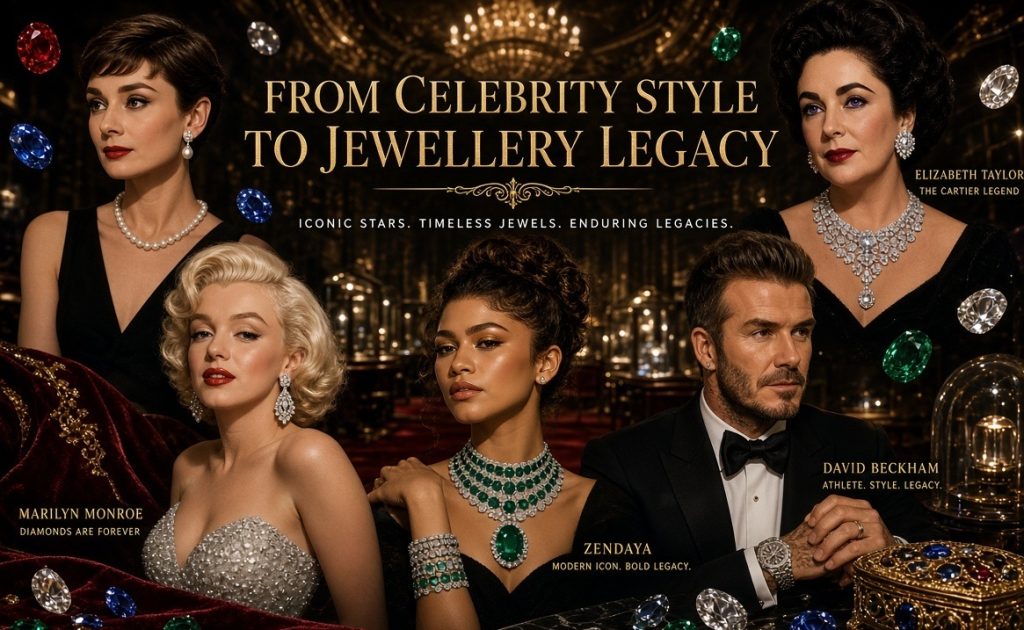
From Celebrity Style to Jewellery Legacy
Jewellery has always been more than an accessory. The right gemstone, cut or design can become part of a person’s identity and when that person is a globally recognised film star, athlete, musician or public figure, the jewellery can become famous in its own right.
For jewellery brands, this presents an extraordinary opportunity.
A celebrity does not necessarily need to create an entire jewellery collection. Sometimes, one distinctive gemstone, one unusual cut, one ring shape or one recognisable design can be enough to create a lasting association between the individual and the jewel.
The history of jewellery is filled with examples of this phenomenon.
Elizabeth Taylor and the Power of the Emerald
Perhaps the greatest example is Hollywood icon Elizabeth Taylor.
Taylor’s extraordinary relationship with jewellery, particularly Bulgari, helped transform individual jewels into cultural icons. During the filming of Cleopatra in Rome, Taylor became a passionate Bulgari client, and her relationship with Richard Burton became intertwined with some of the most famous jewels of the twentieth century. Bulgari itself describes Taylor as one of its most important celebrity admirers.
Her emerald and diamond jewels became particularly associated with her image.
One famous example was an emerald ring Richard Burton gave Taylor while they were filming Cleopatra. The ring featured an octagonal step-cut Colombian emerald and later became part of the celebrated Taylor jewellery collection.
Taylor demonstrated something fundamental about jewellery marketing:
People don’t always remember the technical specifications first. They remember the story.
Elizabeth Taylor + Richard Burton + Cleopatra + Bulgari + emeralds became a powerful combination of romance, Hollywood, wealth and glamour.
Princess Diana and the Sapphire Revolution
Another extraordinary example is Princess Diana’s sapphire engagement ring.
When Diana appeared publicly with her oval blue sapphire surrounded by diamonds in 1981, the jewellery world changed. The ring became one of the most recognisable engagement rings in the world and generated enormous demand for similar sapphire-and-diamond designs.
Today, the ring is worn by Catherine, Princess of Wales, giving the design another generation of visibility.
The lesson for jewellery brands is profound:
A celebrity or public figure can take an existing gemstone and give it a new cultural meaning.
Sapphire did not become valuable because of Diana. It was already a precious gemstone.
But Diana helped make a particular shape, colour combination and design language extraordinarily recognisable.
The Shape Can Become the Brand
The opportunity does not have to be limited to a gemstone.
A jewellery brand could potentially build an identity around:
- An oval sapphire
- A pear-shaped diamond
- An emerald-cut diamond
- A cushion-cut ruby
- A particular halo design
- A distinctive three-stone ring
- A recognisable tennis bracelet
- A signature necklace
- A particular combination of gemstone colours
- A unique setting or silhouette
The objective is to create visual recognition.
Imagine, for example, a famous athlete consistently wearing a distinctive emerald-cut diamond ring. Over time, fans begin associating that shape with the athlete.
The brand can then develop a collection around the same design language available in diamonds, sapphires, rubies and emeralds at different price points.
The celebrity becomes the storyteller.
The jewellery becomes the symbol.
Sport Can Be Just as Powerful as Hollywood
The opportunity extends well beyond actors.
Elite sportspeople have enormous global audiences and, increasingly, their personal style has become part of their public identity.
A footballer, basketball player, tennis champion or Formula 1 driver could collaborate with a jewellery house to develop a signature piece.
For example, a sports personality might choose a particular gemstone representing their nationality, birth month, team colours or personal journey.
An Australian sporting personality could build a collection around Australian sapphires.
A tennis champion might create a collection based around a distinctive tennis-bracelet concept.
A footballer might develop a diamond motif incorporating a number, symbol or shape associated with their career.
The commercial opportunity comes from turning personal identity into a repeatable jewellery design.
Couples Can Create Jewellery Stories
Celebrity couples offer another powerful opportunity.
A famous couple can make a particular jewellery style part of their shared identity an engagement ring, matching bracelets, eternity rings or a signature gemstone.
The story becomes emotional rather than purely commercial:
“This is the stone we chose.”
That story can then be translated into a jewellery collection.
The same principle was demonstrated spectacularly by Elizabeth Taylor and Richard Burton. Their relationship was repeatedly associated with extraordinary jewellery gifts, including emeralds, diamonds, sapphires and other important gemstones. Taylor’s collection eventually became so famous that her 2011 auction at Christie’s set records for a jewellery collection.
The Modern Influencer Creates a Different Opportunity
Social media has fundamentally changed this model.
A traditional celebrity might influence millions of people through a film, television appearance or red-carpet event.
An influencer can potentially influence an audience every day.
That creates an opportunity to introduce a jewellery design repeatedly:
Wear it. Photograph it. Explain it. Tell the story. Repeat it.
Over time, the audience becomes familiar with the design.
This repetition is important. A jewellery icon is rarely created from one photograph.
The Princess Diana sapphire ring is a perfect example. Its influence has continued for decades because the design has repeatedly appeared in public life and has been passed from Diana to Kate.
The DCLA Perspective: Why Identification Matters
For the jewellery industry, however, celebrity influence must be matched by gemmological credibility.
If a celebrity launches a “signature emerald”, for example, consumers need to know exactly what they are buying.
Is it a natural emerald?
Is it treated?
Where did it originate?
What is the colour and clarity?
How has it been graded?
Likewise, if a celebrity promotes a particular diamond shape or quality, the consumer should be able to distinguish between marketing language and objective gemmological information.
This is where an independent laboratory such as the Diamond Certification Laboratory of Australia (DCLA) can play an important role.
A celebrity may create the desire.
A jewellery designer may create the product.
But independent gemmological assessment can provide the confidence behind the product.
From Celebrity to Collectible
The ultimate goal is to create something that survives the celebrity.
That is the difference between a celebrity endorsement and a genuine jewellery legacy.
The strongest examples become part of popular culture.
Elizabeth Taylor helped make emerald jewellery synonymous with Hollywood glamour.
Princess Diana helped make the oval sapphire engagement ring an enduring symbol of romance.
Kate Middleton subsequently gave that same design another generation of visibility.
The next generation of jewellery icons could come from an actor, athlete, musician, entrepreneur, influencer or even a celebrity couple.
The formula is relatively simple:
Personality + Story + Gemstone + Design + Repetition + Authenticity = Recognition.
The real opportunity for today’s jewellery industry is not simply to put a famous person’s name on a piece of jewellery.
It is to create something that people immediately recognise without needing to see the name.
That is when a jewellery piece stops being merchandise and starts becoming an icon.
And that is how a sapphire, ruby, emerald, diamond, cut or distinctive shape can move from being a beautiful gemstone to becoming a brand of its own.
Comments are closed