
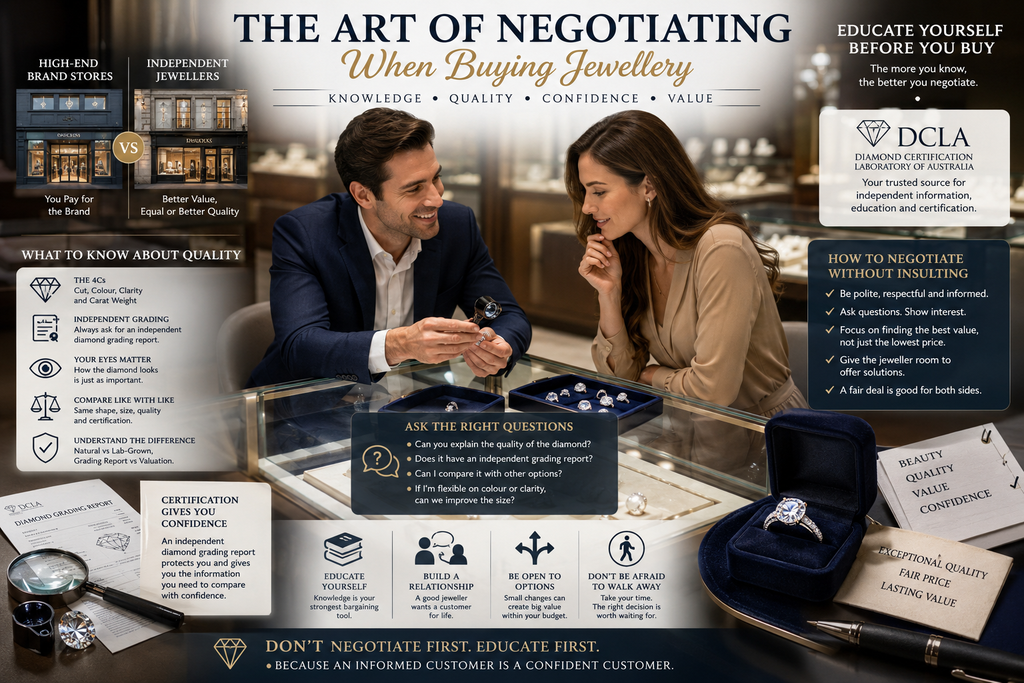
Knowledge Is Your Greatest Bargaining Tool
Buying fine jewellery should be an enjoyable experience. But when you are spending thousands or even tens of thousands of dollars, it also pays to understand how the jewellery business works and how to negotiate intelligently.
There is a common perception that the safest way to buy jewellery is to purchase from a famous high-end brand. There is certainly value in brand heritage, design, presentation and prestige. However, the name on the door can also come with a significant premium.
The reality is that an excellent diamond or beautifully crafted piece of jewellery does not necessarily need a famous name attached to it.
In many cases, independent brick-and-mortar jewellers can offer an equal and sometimes better product at a price that is considerably more accessible.
The key is knowing what you are buying.
And that is where education becomes your greatest advantage.
Don’t Negotiate Blind
The biggest mistake a jewellery buyer can make is walking into a showroom knowing what they want to spend but not knowing what they are actually buying.
If you tell a jeweller:
“I have $15,000 to spend. What can you give me?”
you have immediately given away one of your strongest negotiating positions.
Instead, educate yourself first.
Understand the diamond’s 4Cs cut, colour, clarity and carat weight. Understand the difference between natural and laboratory-grown diamonds. Understand the importance of an independent grading report and learn how small differences in diamond quality can have a significant effect on price.
DCLA’s consumer education programs are specifically designed to help buyers understand these factors, including how to evaluate diamonds, compare grading reports and ask the right questions when dealing with jewellers.
Once you understand the product, the conversation changes.
You are no longer simply asking, “How much is this ring?”
You are asking:
“What exactly am I getting for my money?”
That is a much more powerful question.
The Brand Name Is Not the Diamond
High-end jewellery houses have invested enormous amounts of money building their brands.
You are paying for the design, the store, the advertising, the packaging, the celebrity associations, the shopping experience and the prestige associated with the name.
There is nothing wrong with that.
If owning a particular brand is important to you, then the brand itself has value.
But if your priority is the quality and beauty of the jewellery rather than the name, you may find another opportunity.
An independent jeweller may be able to put more of your budget into the actual diamond, precious metal and craftsmanship rather than into the cost of maintaining a global luxury brand.
This is where an educated buyer can potentially find exceptional value.
The Independent Jeweller Can Be Your Friend
The best independent jewellers understand that their reputation is built one customer at a time.
They may be prepared to discuss different diamonds, alternative designs, different metals and different price points. They may also have greater flexibility when it comes to margins than a large international luxury brand.
But there is an important distinction between negotiating and haggling.
Negotiating is about finding a fair deal.
Haggling is about trying to beat someone down.
A professional jeweller deserves to make a reasonable margin. After all, they have invested in their premises, staff, manufacturing, expertise, stock and years of experience.
The objective should not be:
“How cheaply can I get this?”
It should be:
“Can we arrive at a price that represents good value for both of us?”
That approach is far more likely to produce a positive result.
How Do You Negotiate Without Insulting the Jeweller?
This is an art in itself.
Don’t walk into a showroom and announce:
“That’s ridiculously expensive. I’ll give you half.”
You may have just ended the conversation.
Instead, demonstrate that you have done your homework.
Ask questions.
“Can you explain the quality of the centre diamond to me?”
“Does the diamond have an independent grading report?”
“Is this a natural or laboratory-grown diamond?”
“Can I compare this diamond with another one of similar specifications?”
“If I was flexible on the colour or clarity, could we improve the size without increasing the budget?”
These are intelligent questions.
They tell the jeweller that you are serious, informed and interested in making a purchase but that you are also looking for genuine value.
Certification Gives You Confidence
When purchasing a significant diamond, one of the most important pieces of information is an independent diamond grading report.
A grading report provides an objective description of the diamond’s characteristics. It is fundamentally different from a valuation, which estimates a monetary value at a particular point in time.
DCLA recommends independent certification because a report produced by a retailer or merchant who has a financial interest in the diamond is not independent.
This is particularly important when comparing diamonds from different jewellers.
You need to make sure you are comparing like with like.
A diamond described as “G colour VS1” by one seller is not necessarily equivalent in overall quality and appearance to another diamond carrying the same description. Cut quality, proportions, fluorescence and other characteristics can all influence how a diamond looks and how the market values it.
The certificate is therefore only the beginning.
You still need to look at the diamond.
Your Eyes Matter
Diamond grading provides important information, but jewellery is ultimately something you are going to wear and enjoy.
Two diamonds with similar grades can look different to the eye.
Cut quality can have a profound effect on brilliance and life, and DCLA notes that cut is often regarded as one of the most important characteristics because a poorly cut diamond can appear dull even when colour and clarity are excellent.
Don’t become so obsessed with chasing a particular grade that you forget the purpose of the purchase.
You want a beautiful diamond.
Sometimes moving slightly down in one characteristic can allow you to move significantly up in another without creating a visible difference to the naked eye.
That is where knowledge can save you money.
Ask What You Can Change
One of the most effective negotiating techniques is not simply asking:
“Can you lower the price?”
Instead ask:
“How can we make this better value?”
Perhaps the jeweller can:
- Find a different diamond with a better price.
- Increase the diamond size while adjusting colour or clarity.
- Change the setting design.
- Use a different precious metal.
- Modify the diamond shape.
- Source an alternative stone.
- Improve the overall specification within the same budget.
This creates a conversation rather than a confrontation.
And a good jeweller may actually enjoy the challenge of finding the right solution.
Don’t Be Afraid to Walk Away
One of your greatest negotiating strengths is the ability to say:
“Thank you. I’ll think about it.”
Never feel pressured into buying jewellery simply because you have spent an hour in a showroom.
Take the information home.
Compare it.
Research the diamond.
Check the grading report.
Look at alternatives.
Then decide.
A reputable jeweller should be comfortable with you taking time to make an important financial decision.
Educate Yourself Before You Enter the Jewellery Store
The smartest jewellery buyer doesn’t start negotiating when they walk into the store.
They start educating themselves before they ever meet the seller.
Learn what the 4Cs mean.
Understand certification.
Learn how natural and laboratory-grown diamonds differ.
Understand how diamond shape affects appearance and price.
Know the difference between a grading report and a valuation.
Learn what questions to ask.
And most importantly, understand what matters to you.
DCLA’s diamond education resources and consumer workshops are designed to help buyers understand diamonds, grading, certification, value and the questions they should ask before purchasing.
The DCLA Advantage
At DCLA, we believe an educated consumer is a confident consumer.
Our role is not simply to grade diamonds. It is to provide consumers with the knowledge and independent information they need to make better decisions.
Before you negotiate the price of a diamond, understand the diamond.
Before you compare two jewellers, understand what they are offering.
Before you spend your money, understand where that money is going.
Don’t be intimidated by the jewellery industry. Educate yourself and enter the conversation with confidence.
You may discover that the best diamond for your budget isn’t sitting behind the doors of the most famous luxury brand.
It may be sitting in an independent jeweller’s showroom waiting for an educated buyer who knows exactly what to look for.
The DCLA Rule for Buying Jewellery
Don’t negotiate first. Educate first.
Because when you know what you are buying, you don’t need to be an aggressive negotiator.
You simply become an informed customer and informed customers are much harder to overpay.
Comments are closed