
Understanding diamonds requires more than learning the Four Cs. It requires scientific knowledge, practical experience, access to the right technology and, most importantly, education based on internationally recognisedFour Csstandards.
Diamonds are among the most fascinating and technically complex natural materials in the world. Understanding their quality, identifying their characteristics and determining their true grading requires a combination of scientific knowledge, practical training and years of experience.
For anyone considering a career in the diamond industry, whether as a jeweller, diamond grader, gemmologist, diamond dealer, manufacturer or independent professional, choosing the right education is one of the most important decisions they will make.
But where should you start, what should you learn, and how do you know whether the education you receive will be recognised and respected by the international diamond trade?
The answer lies in understanding the difference between learning about diamonds, becoming a qualified gemmologist and developing the specialist skills required to grade diamonds professionally.
1. Understanding the foundations: Diamond technology and gemmology
Diamond education covers several disciplines, each providing a different level of understanding.
Gemmology is the scientific study of gemstones. It involves understanding their physical, optical and chemical properties, how they form, how they are identified and how they can be distinguished from other gemstones and imitations.
Diamond technology takes this knowledge further into the specialised world of diamonds. It includes:
- The geological formation and characteristics of natural diamonds.
- Diamond crystal structures and optical properties.
- Mining, rough diamond evaluation and manufacturing.
- Cutting, polishing and diamond proportions.
- Diamond identification and detection of laboratory-grown diamonds.
- Detection of treatments and enhancements.
- Advanced diamond grading and laboratory technology.
- The relationship between diamond quality, rarity and market value.
A professional diamond education should not simply teach students to recognise a D colour or an SI1 clarity grade. It should explain why those grades are awarded, how they are determined, what equipment is required and how different characteristics influence the appearance and quality of an individual diamond.
2. Learning the Four Cs: The foundation of diamond grading
The internationally familiar Four Cs provide the starting point for understanding polished diamond quality.
Carat Weight: The precise weight of a diamond, measured in carats. One carat equals 0.20 grams.
Colour: The degree to which a diamond is colourless or displays a noticeable body colour. The traditional D-to-Z grading scale is used for diamonds in the normal colour range.
Clarity: The assessment of internal inclusions and external blemishes, taking into account their nature, size, number, position and visibility.
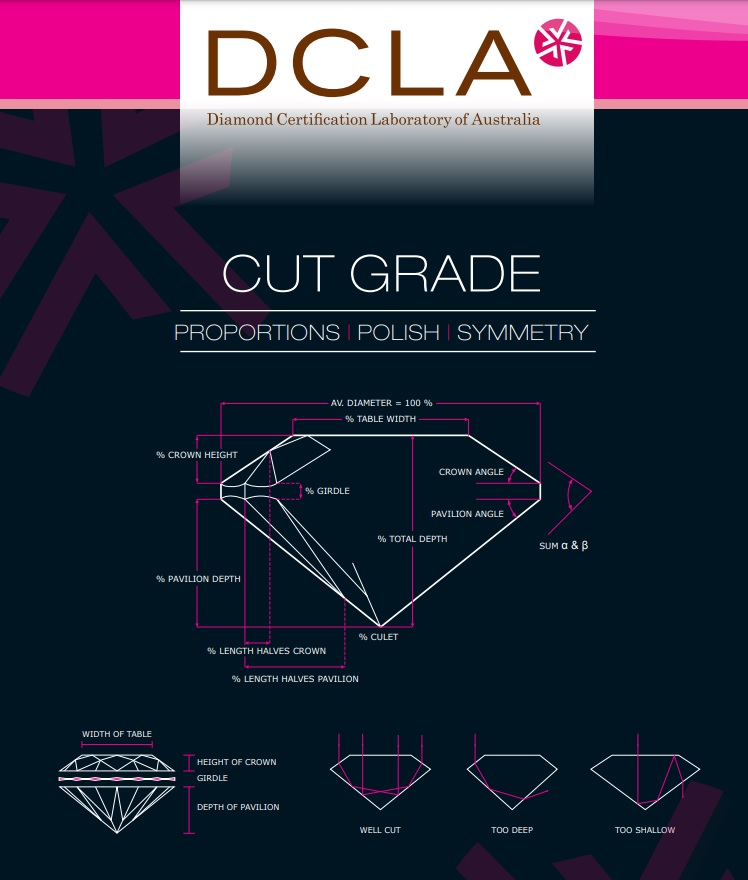
Cut: The assessment of a diamond’s proportions and finish, including polish and symmetry, which influence its optical performance.
However, the Four Cs are only the beginning. A proper education must also cover fluorescence, transparency, proportions, facet arrangement, brilliance, fire, scintillation and the individual characteristics that make every diamond different.
DCLA provides a useful starting point through its educational resources:
- DCLA Diamond Clarity Guide
- DCLA Diamond Grading Process
- DCLA Diamond Grading Reports
- DCLA Diamond Glossary and Picture Library
The DCLA glossary is particularly useful because it introduces the terminology used throughout the diamond trade, supported by explanations and visual examples.
Understanding terms such as inclusions, feathers, clouds, girdle, pavilion, crown, culet, fluorescence, brilliance and scintillation is essential before attempting to grade diamonds professionally.
3. Where should you study? Understanding the leading international institutions
There are several established organisations offering diamond grading, gemmology and professional education. Each has its own history, programmes, qualifications and areas of specialisation.
Choosing between them depends on what you want to achieve and whether your goal is to work in jewellery, gemmology, diamond grading, manufacturing or an independent laboratory.
GIA – Gemological Institute of America
The Gemological Institute of America (GIA) is one of the world’s best-known gemmological institutions.
Founded in 1931, GIA has played an important role in developing modern gemmological education and diamond grading.
Its programmes include the Graduate Gemologist qualification, diamond grading courses and specialist education in gemstone identification.
GIA education covers the Four Cs, diamond identification, grading procedures, gemstone properties and laboratory techniques.
For students wanting a comprehensive introduction to gemmology and diamond grading, GIA is an important institution to consider.
HRD Antwerp – Diamond High Council
HRD Antwerp is based in Antwerp, Belgium, one of the world’s historic diamond trading and manufacturing centres.
HRD Antwerp offers professional diamond education, including diamond grading and gemmological programmes.
Its educational approach combines theoretical knowledge with practical diamond assessment, helping students understand the relationship between rough diamonds, polished stones, quality characteristics and professional grading.
Studying in Antwerp also provides exposure to one of the most established diamond trading environments in the world.
IGI – International Gemological Institute
The International Gemological Institute (IGI) is an internationally established gemmological organisation providing education, diamond grading and gemstone identification services.
IGI offers educational programmes covering diamond grading, gemmology, jewellery and the identification of natural and laboratory-grown diamonds.
Its education is particularly relevant in today’s market, where professionals must understand the differences between natural diamonds, laboratory-grown diamonds and diamond simulants.
AGS – American Gem Society
The American Gem Society (AGS) has a long-standing history in professional jewellery education and consumer protection.
Its educational programmes and professional resources cover diamond grading, ethical business practices and jewellery industry standards.
AGS is particularly recognised for its work in cut quality assessment and the development of its own cut grading approach, including the performance-based assessment of light behaviour in diamonds.
For anyone wanting to understand diamond cut beyond simply looking at a certificate, AGS educational material is worth exploring.
DCLA – Diamond Certification Laboratory of Australia
The Diamond Certification Laboratory of Australia (DCLA) provides an Australian perspective on professional diamond grading, technology and certification.
DCLA’s resources cover diamond identification, grading methodology, the Four Cs, transparency, fluorescence, diamond treatments and the technology used in modern diamond laboratories.
One of the most important aspects of learning from an operational diamond laboratory is understanding how theoretical grading principles are applied to real diamonds.
DCLA’s grading process involves precision weighing, computerised measurements, controlled lighting, registered master diamonds, microscopic clarity examination, plotting and the assessment of proportions, polish, symmetry and transparency.
Students and professionals can also benefit from understanding how independent laboratory procedures and quality control protect the integrity of a grading result.
4. The International Diamond Council: Why standardised nomenclature matters
One of the most important developments in the modern diamond industry was the establishment of the International Diamond Council (IDC) in 1975.
The IDC originated from a joint initiative of the World Federation of Diamond Bourses (WFDB) and the International Diamond Manufacturers Association (IDMA), following the 18th World Diamond Congress in Amsterdam.
The objective was straightforward but extremely important: to establish internationally recognised rules, working methods and nomenclature for grading polished diamonds.
Before internationally coordinated grading rules, differences in terminology and grading practices could create confusion between diamond markets and trading centres.
A diamond described using one set of grading terms in one country needed to be understood consistently by professionals in another.
The IDC was established to address this problem.
Its objectives included:
- Establishing internationally recognised diamond grading standards.
- Developing consistent terminology and nomenclature.
- Normalising the methods used to apply grading standards.
- Encouraging recognised diamond institutions and laboratories to adopt accepted grading practices.
In 1978, the International Rules for Grading Polished Diamonds were proposed at the 19th World Diamond Congress in Tel Aviv and unanimously approved by the WFDB and IDMA general assemblies.
These rules became an important reference point for the international diamond trade.
The IDC Rules provide a common framework for describing and grading polished diamonds, helping diamond professionals communicate using recognised terminology across international markets.
This is particularly important when diamonds are traded between Antwerp, New York, Tel Aviv, Mumbai, Hong Kong, Sydney and other major diamond centres.
The IDC continues to publish its rules and terminology through its official website.
Read more: International Diamond Council – History and Objectives.
International Diamond Council – Official Rules and Definitions.
DCLA incorporates IDC grading rules into its diamond grading methodology. Its reports are intended to provide an internationally understandable description of a diamond’s characteristics.
It is important to understand that the IDC provides the industry framework; individual laboratories remain responsible for their own grading procedures, quality controls and professional assessments.
5. Why practical experience is just as important as qualifications
One of the biggest mistakes people make when entering the diamond industry is assuming that completing a course automatically makes them an expert diamond grader.
A qualification provides a foundation, but professional grading requires considerable practical experience.
Two diamonds can have the same carat weight, colour and clarity grades and still look very different.
An experienced grader must learn to recognise the differences between inclusions, understand their position and visibility, assess transparency, evaluate proportions and identify characteristics that may influence the overall appearance of a stone.
For example, two diamonds graded SI1 may have very different inclusion characteristics. One may have a small inclusion positioned near the edge, while another may contain a more centrally located feature that is more noticeable.
The clarity grade alone does not tell the complete story.
This is why professional education should involve working with actual diamonds, comparing master stones, using microscopes and understanding the grading equipment employed by established laboratories.
It is also important to learn how to identify laboratory-grown diamonds and detect treatments. Modern diamond laboratories increasingly rely on advanced screening and spectroscopic technology to distinguish natural diamonds from laboratory-grown material and identify certain treatments.
A good education should prepare students to understand both traditional diamond grading and the technological changes taking place throughout the industry.
6. Why learning from the right source makes a difference
The diamond industry is international, and professional credibility depends on more than a certificate hanging on the wall.
The institution providing the education, the grading methodology being taught, the experience of the instructors and the practical exposure students receive all matter.
An education based on recognised international terminology and grading methodology gives students a common professional language.
It helps a jeweller communicate more accurately with suppliers, a dealer assess diamonds more confidently, an insurer understand grading reports and a laboratory professional apply consistent grading procedures.
For anyone considering a career in diamonds, it is worth asking several questions before enrolling:
- Does the course follow recognised international diamond grading terminology?
- Is the education supported by practical grading exercises?
- Are students taught to work with master stones and professional grading equipment?
- Does the programme cover natural and laboratory-grown diamond identification?
- Are treatments, enhancements and transparency explained?
- Does the qualification have industry recognition and a clear professional pathway?
The right education can open doors, but ongoing experience, independent judgement and professional integrity are what build a lasting reputation.
7. DCLA: Bringing international diamond grading knowledge and technology to Australia
Australia has a long association with the diamond industry, from the historic Argyle diamond mine to the international trade in polished diamonds and fine jewellery.
Yet access to specialist diamond grading knowledge and advanced laboratory technology is just as important here as it is in the world’s major diamond centres.
DCLA, the Diamond Certification Laboratory of Australia, was established to bring internationally recognised diamond grading standards, professional expertise and advanced certification technology to the Australian market.
DCLA’s approach combines internationally recognised grading principles with independent laboratory assessment and modern diamond identification technology.
Its grading process includes independent examination, with multiple professional graders assessing each diamond before final grades are approved through laboratory quality control.
DCLA also recognises that a diamond’s appearance cannot always be fully explained by the traditional Four Cs. Its additional transparency assessment provides further information about the optical characteristics of a diamond.
For students, jewellers and diamond professionals, DCLA’s educational resources provide an opportunity to develop a deeper understanding of diamond grading and the technology behind modern certification.
Explore the DCLA Diamond Glossary and Picture Library and the DCLA Technology and Grading Process.
Conclusion: Knowledge is the foundation of professional credibility
Learning diamond technology, grading and gemmology is a journey rather than a single qualification.
Institutions such as GIA, HRD Antwerp, IGI and AGS have made important contributions to professional education and the development of the international diamond industry. The International Diamond Council has played a significant role in establishing common grading rules and nomenclature, allowing professionals across the world to communicate using a recognised framework.
But the most valuable education combines recognised theory with practical experience, modern technology and access to professionals who understand diamonds beyond the textbook.
Whether you are starting a career in diamonds, expanding your knowledge as a jeweller or developing the skills required to work in a professional grading laboratory, choosing the right source of education makes all the difference.
In the diamond industry, knowledge is not simply about knowing the grades. It is about understanding the diamond.
- DCLA: Diamond Glossary and Picture Library · Technology and Grading Process · Diamond Education · Diamond Clarity.
- IDC: History, objectives and establishment of international grading rules · Official diamond definitions.
- GIA: Graduate Gemologist programme.
- HRD Antwerp: Official education and laboratory website.
- IGI: School of Gemology and professional courses.
- AGS: American Gem Society education and resources.
Comments are closed