
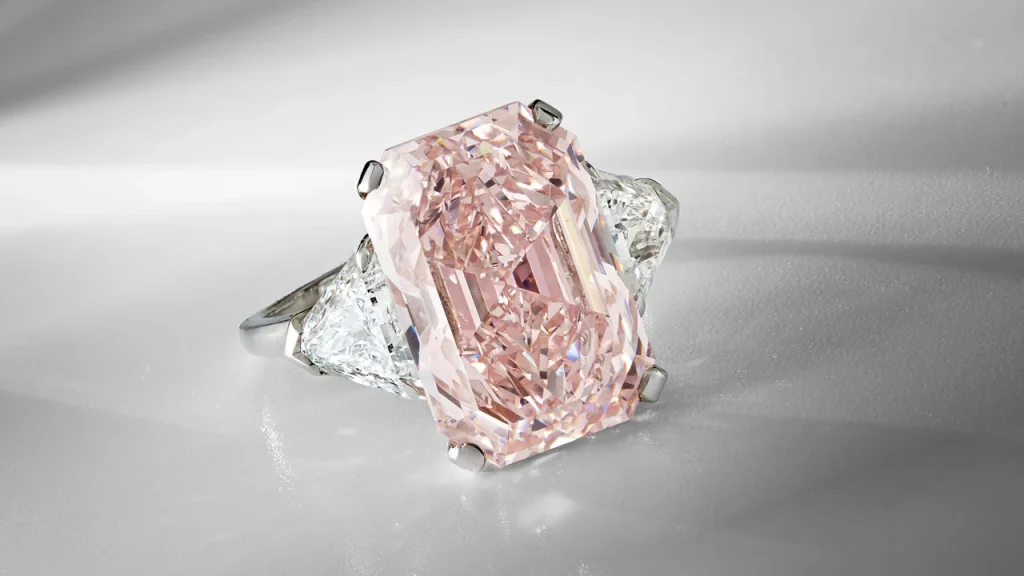
A remarkable 14.63 carat fancy orangey pink natural diamond is set to be one of the highlights of Christie’s upcoming Geneva jewellery auction, with the David Morris ring carrying an upper estimate of approximately US$2.6 million.
The exceptional stone will be offered as part of Christie’s Exceptional Jewels & Objects of Elegance: A Connoisseur’s Collection, taking place in Geneva on November 10, with an accompanying online auction running from November 5 to 17.
The private collection comprises almost 300 lots and includes important jewellery from internationally recognised maisons including Van Cleef & Arpels, Bulgari and Graff, alongside Art Deco vanity cases and finely crafted gold objects.
Why are natural pink diamonds pink?
Pink diamonds are among the most intriguing of all natural diamonds because, unlike many other coloured diamonds, their colour is not easily explained by the presence of a specific trace element.
The colour of a natural pink diamond is generally associated with changes in the diamond’s crystal structure that occurred deep within the Earth during its formation. Diamonds are made from carbon atoms arranged in an exceptionally precise crystal lattice. In some diamonds, geological forces cause distortions within that lattice.
These microscopic structural distortions affect the way light passes through the diamond, producing the remarkable pink colour that makes these stones so desirable.
When the colour moves towards orangey pink, the diamond displays a combination of pink and orange body colour. The precise appearance can vary considerably from one diamond to another, ranging from delicate pastel tones to highly saturated and vivid colours.
This is one reason every exceptional natural coloured diamond is effectively unique.
For more information about diamond structure, properties and the differences between natural and laboratory-grown diamonds, see DCLA’s guide to What Is a Diamond? Natural vs Laboratory-Grown – Structure, Science and Pricing.
Why are pink diamonds so rare?
Natural diamonds occur in many parts of the world, but diamonds with a strong and attractive natural pink colour are extraordinarily uncommon.
Diamonds are formed under immense pressure and temperature deep within the Earth’s mantle and can take billions of years to reach the surface through geological processes. Only a very small proportion develop the particular crystal characteristics responsible for a natural pink colour.
Importantly, pink diamonds are not confined to one location. Natural pink diamonds have been discovered in diamond-producing regions around the world. However, the supply of fine-quality pink diamonds is exceptionally limited.
The rarity becomes even greater when factors such as carat weight, colour intensity, clarity, cut and overall beauty are taken into account.
A large pink diamond with strong colour and good clarity is therefore extraordinarily difficult to find.
DCLA has explored the extraordinary rarity of large natural diamonds in its article Nature vs Technology: Why Large Natural Diamonds Are Exceptionally Rare, explaining why increasing diamond size results in dramatically greater natural scarcity.
Size changes everything
With coloured diamonds, rarity increases dramatically as size increases.
A small natural pink diamond may already be a scarce gemstone, but a large stone with an attractive, saturated colour can be in an entirely different category.
The 14.63 carat diamond being offered in Geneva is therefore significant not simply because it is pink, but because of its combination of natural colour, substantial size and orangey pink appearance.
At more than 14 carats, the stone belongs to a category where the number of comparable natural diamonds available to the market is extremely small.
This scarcity is one of the fundamental reasons exceptional pink diamonds can command prices far beyond those of similarly sized colourless diamonds.
Natural colour is the key
The distinction between a natural coloured diamond and a treated or laboratory-grown diamond is particularly important when discussing rare pink diamonds.
A natural pink diamond has acquired its colour through the geological processes that formed the stone over an immense period of time. The colour is part of the diamond’s natural characteristics.
Modern technology can produce laboratory-grown diamonds and can also alter the colour of diamonds through various treatments. These stones can be beautiful in their own right, but they are fundamentally different from a rare natural coloured diamond.
For an important natural coloured diamond, independent examination and documentation are therefore critical.
DCLA explains the importance of determining diamond origin in its article Natural or Laboratory-Grown? How Can You Tell What Diamond Is in Your Ring?, which explains why visual examination or a basic diamond tester cannot reliably establish whether a diamond is natural or laboratory-grown.
The challenge of grading coloured diamonds
Coloured diamonds are assessed differently from traditional colourless diamonds.
The colour itself is a major component of the stone’s rarity and desirability, with factors including hue, tone and saturation playing an important role.
Two diamonds of exactly the same carat weight can therefore have dramatically different values because their colours differ in strength, distribution and attractiveness.
For a buyer or collector, establishing whether the colour is natural, determining the characteristics of the diamond and confirming any treatments is essential.
At the Diamond Certification Laboratory of Australia (DCLA), diamonds undergo detailed examination using advanced laboratory technology. DCLA states that every diamond is screened for known treatments, tested to establish whether it is natural or man-made, and graded according to International Diamond Council (IDC) rules.
Learn more about the DCLA Diamond Grading and Certification Process.
Why independent certification matters
With an exceptionally rare coloured diamond, establishing exactly what the stone is becomes particularly important.
A DCLA diamond grading report provides a technical breakdown including carat weight, colour, clarity, measurements, stone type, treatments or enhancements, cut, symmetry, polish, transparency and fluorescence.
For rare natural coloured diamonds, documentation can therefore become an important part of the stone’s history and provenance.
DCLA’s Diamond Grading Report service provides independent documentation of the diamond’s characteristics.
Why exceptional pink diamonds command exceptional prices
The market for the finest natural pink diamonds is ultimately driven by a simple combination:
Nature created very few of them, and the world’s supply cannot simply be increased.
A large, naturally coloured pink diamond with attractive colour, good clarity and excellent cutting represents the convergence of several rare characteristics.
This scarcity is particularly important in today’s diamond market. While laboratory-grown diamonds can be produced using controlled manufacturing processes, the supply of large, exceptional natural diamonds remains limited by geology.
DCLA’s research into the changing natural diamond market notes that large, rare and unusually coloured natural diamonds continue to command strong premiums because of their exceptional rarity and provenance.
The Christie’s Geneva offering demonstrates the continuing fascination with these extraordinary natural treasures. While the US$2.6 million upper estimate is substantial, the importance of the stone extends beyond its auction price.
It is a reminder that in the world of natural diamonds, rarity is not simply about size. It is about how many times nature was able to create the right combination of colour, structure, clarity, size and beauty.
And when that combination occurs naturally, there may be very few comparable diamonds anywhere in the world.
DCLA — Independent Diamond Expertise
For consumers, collectors, jewellers and insurers, independent examination can provide confidence that a diamond is accurately identified and documented.
Diamond Certification Laboratory of Australia (DCLA) is Australia’s internationally accredited diamond certification laboratory, providing independent grading and testing of natural and laboratory-grown diamonds in its Sydney laboratory.
DCLA — Where nature’s rarest diamonds meet independent science.
Comments are closed