
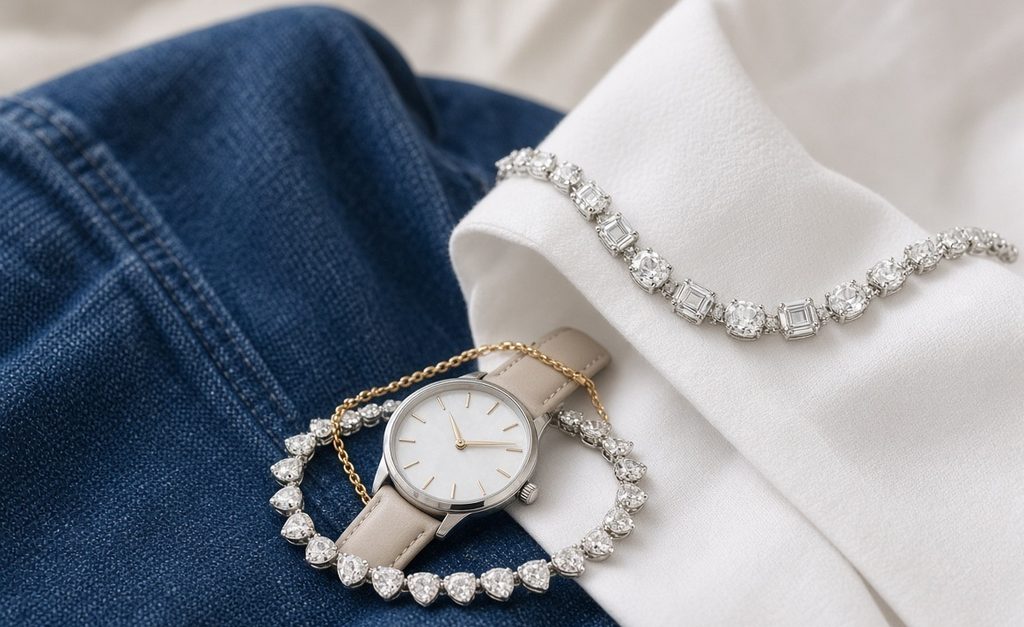
Some jewellery designs never truly go out of fashion.
Diamond tennis bracelets, rivière necklaces, diamond studs and classic pendants have remained among the most recognisable and enduring pieces in fine jewellery. Their appeal is easy to understand: they are elegant, versatile and can be worn for almost any occasion.
But today’s jewellery customers are increasingly looking for something more than a traditional piece. They want the beauty and familiarity of classic diamond jewellery while incorporating a more contemporary style that reflects their individual personality.
This is creating an interesting new direction in jewellery design: reimagining the classics rather than replacing them.
For customers considering a completely individual piece, DCLA also offers Bespoke Jewellery services, combining traditional diamond knowledge with contemporary design.
The return of the classics with a modern attitude
A traditional diamond rivière, for example, has historically been associated with formal occasions and evening wear. Today, the same concept can be transformed into something far more relaxed and versatile.
A diamond necklace can be worn with a simple shirt and jeans just as easily as with an evening gown. A tennis bracelet can be worn on its own for understated elegance or combined with gold bracelets, watches and other pieces to create a layered, contemporary look.
Diamond studs are also being reinvented. Instead of simply choosing two traditional round brilliant diamonds, customers are increasingly considering pear, marquise, princess, oval and other shapes, as well as modern settings and designs that give the classic stud a completely different appearance.
DCLA’s Diamond Shape guide provides information on the many different shapes available and how they influence the appearance and character of a diamond.
According to Michael Cohen, designer at the DCLA Diamond Exchange in Sydney, this shift reflects a broader change in the way people think about jewellery.
“The classic diamond has never lost its appeal. What is changing is the way people want to wear it. Customers are looking for jewellery that feels personal and contemporary while still having the quality and timelessness associated with traditional diamond jewellery.”
Layering creates individuality
One of the biggest changes in modern jewellery styling is the popularity of layering.
Instead of wearing a single necklace, bracelet or ring, customers can combine several pieces of different lengths, textures and designs.
A classic diamond necklace might be worn alongside a fine gold chain. A tennis bracelet can sit next to a watch or be stacked with plain gold and gemstone bracelets. Several delicate rings can be combined to create a look that changes from day to day.
This approach allows a traditional diamond piece to become part of a much more relaxed wardrobe.
The beauty of layering is that there are no strict rules. A customer can combine old and new, understated and extravagant, polished and casual.
Changing the diamond shape changes the entire look
The modernisation of classic jewellery is not limited to the setting. The diamonds themselves can dramatically change the character of a piece.
Round brilliant diamonds remain enormously popular, but fancy shapes such as oval, pear, marquise, emerald, princess and baguette cuts can give traditional jewellery a very different personality.
A rivière made entirely from round diamonds has a very different appearance from one incorporating graduated oval or emerald-cut stones.
Similarly, a tennis bracelet using pear-shaped diamonds can create a softer, more flowing appearance, while baguette diamonds can produce a sharper and more architectural design.
This gives designers enormous scope to create jewellery that is recognisably classic while still appearing completely modern.
DCLA’s Natural Diamond Search allows customers and industry professionals to explore diamonds by shape, including round, oval, pear, emerald, princess, radiant, marquise, baguette and many other shapes.
Colour can make a classic piece contemporary
Another increasingly popular design approach is the use of contrasting metals and subtle touches of colour.
Platinum or white gold can provide a clean, contemporary background for diamonds, while yellow gold can introduce warmth and contrast.
Coloured gemstones can also be incorporated into otherwise traditional diamond jewellery. A single sapphire, ruby or emerald can become a focal point within an otherwise diamond-dominated design.
Even small details can make a significant difference.
A traditional diamond bracelet with an unusual clasp, mixed-metal elements or a distinctive arrangement of diamond shapes can feel like an entirely new creation.
For coloured diamonds and unusual diamond characteristics, understanding the stone itself is particularly important. DCLA’s Diamond Certification service records important characteristics including colour, clarity, carat weight, proportions and other identifying features.
Jewellery designed to be worn, not stored
Perhaps the most important change is the attitude towards when fine jewellery should be worn.
For generations, diamonds were often associated with weddings, anniversaries, special celebrations and formal events. Modern customers are increasingly choosing to wear their fine jewellery as part of everyday life.
A beautiful diamond bracelet does not necessarily need to wait for a black-tie event.
Worn with denim, a simple shirt, a watch or casual clothing, a classic diamond can provide a subtle touch of luxury without appearing overly formal.
This makes versatility an increasingly important part of jewellery design.
The importance of timeless design
There is also a practical reason why classic designs continue to attract customers.
Fashion changes quickly. Jewellery can be expensive, and customers naturally want pieces they will continue to enjoy wearing for many years.
A completely trend-driven design may look spectacular today but can become dated as fashions change. A well-designed classic, however, can remain relevant while allowing the owner to style it differently over time.
A properly documented diamond can also provide important information for the owner over the years. DCLA’s Diamond Grading Report records the diamond’s technical characteristics, including carat weight, colour, clarity, measurements, cut, symmetry, polish and whether the stone is natural or laboratory-grown.
The importance of knowing what you are buying
Modern jewellery design also means consumers have more choices than ever before.
Natural diamonds and laboratory-grown diamonds can both be used to create beautiful jewellery, but they are different types of diamond and should be correctly identified and represented.
DCLA provides grading and certification for both natural and laboratory-grown diamonds, with its laboratory using advanced technology to identify and assess diamonds.
For customers purchasing a new piece or redesigning an existing one, independent grading can provide useful documentation about the diamond being used.
DCLA’s Technology & Grading Process explains how diamonds are examined and graded using a controlled, independent process.
Jewellery that can become part of a family’s story
One of the unique qualities of fine diamond jewellery is its ability to move between generations.
A bracelet purchased today may eventually be worn by a daughter or granddaughter. A pair of diamond earrings can be redesigned, reset or incorporated into another piece as styles and personal preferences change.
This is one reason classic diamond jewellery continues to have such enduring appeal.
Rather than thinking of a piece as something that belongs to one particular fashion period, a well-designed diamond jewel can become part of a family’s history.
For an existing family piece, professional examination and documentation can also help an owner understand what they have. DCLA provides Diamond and Jewellery Valuation services as part of its broader range of diamond and jewellery services.
The new classic
The future of fine jewellery may not be about choosing between traditional and contemporary design.
Instead, it is about combining the two.
The timeless appeal of diamonds, combined with modern cuts, creative settings, mixed metals, layering and personalised design, gives today’s customers far more ways to express themselves.
The result is what could be called the new classic: jewellery that respects the designs of the past while being created for the way people live today.
For customers considering a new diamond piece, the message is simple. A classic design does not have to look old-fashioned. With the right design approach, a traditional diamond can be transformed into something contemporary, personal and uniquely your own.
At the DCLA Diamond Exchange in Sydney, the combination of diamond expertise, independent grading and bespoke jewellery knowledge provides customers with the opportunity to take a traditional idea and give it a completely modern interpretation.
Whether it is a family heirloom being redesigned, a classic diamond being incorporated into a new piece, or an entirely new creation, the best modern jewellery does not abandon tradition.
It reinvents it.
Comments are closed