
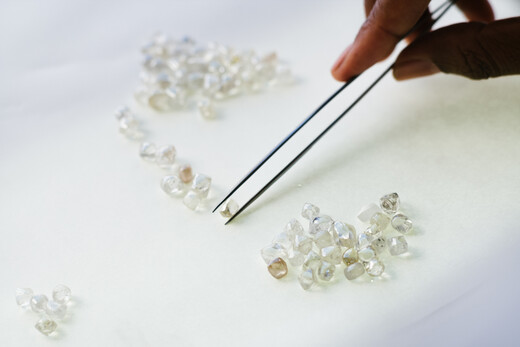
De Beers has released its 2026 sight schedule, confirming it will maintain its traditional 10 rough diamond sales over the 12-month period, providing a degree of operational continuity amid prolonged uncertainty across the global diamond industry.
The miner sells approximately 90% of its rough diamond output to approved sightholders, who commit to purchasing set volumes of rough diamonds in exchange for consistent and predictable supply. In line with this strategy, De Beers has confirmed it will extend its current sightholder agreement through 30 June 2026, ensuring stability within its sight system during a challenging market environment.
The extended contract continues to regulate De Beers’ rough diamond sales, which are sourced from its wholly owned and joint-venture mining operations in Botswana, Namibia and South Africa. Sales will continue to be conducted in these producing countries.
In a minor operational adjustment, De Beers announced that the April and September 2026 sights will be shortened to four days, compared with the traditional five-day format.
De Beers 2026 Sight Dates
- Sight 1: 19–23 January
- Sight 2: 23–27 February
- Sight 3: 23–27 March
- Sight 4: 27–30 April
- Sight 5: 25–29 May
- Sight 6: 6–10 July
- Sight 7: 17–21 August
- Sight 8: 22–25 September
- Sight 9: 26–30 October
- Sight 10: 30 November–4 December
De Beers Cuts Rough Diamond Prices Amid Weak Demand
Alongside the announcement of its 2026 sight calendar, De Beers has reportedly cut rough diamond prices, reflecting mounting pressure from weak demand, surging lab-grown diamond supply and ongoing trade disruptions.
The January reduction marked the company’s first official price cut since December 2024, following months of quietly offering discounts while maintaining official list prices above prevailing market levels. At the first regular sight of the year, De Beers implemented price reductions on rough stones larger than three-quarters of a carat, according to industry sources.
The exact scale of the price cuts remains unclear, as De Beers has adjusted its billing structure and altered the composition of its diamond boxes, making direct comparisons difficult. Under the sight system, De Beers sets prices and indicates expected purchase volumes for sightholders, a structure that continues to give the miner significant influence over the rough diamond market, despite buyers retaining the technical right to refuse goods.
Industry Downturn and Structural Challenges
The global diamond industry is experiencing one of its deepest downturns in decades, with demand and prices for natural diamonds declining sharply from 2023 through 2025. Miners have been forced to scale back production and reassess long-term strategies as market conditions deteriorate.
A major structural challenge has been the rapid rise of lab-grown diamonds, whose prices have collapsed in recent years. This has enabled lab-grown stones to capture increasing market share, particularly in the bridal jewellery segment, undercutting natural diamonds across key consumer categories.
China, once a vital growth engine for diamond jewellery, has become a significant drag on demand due to a slowing economy and declining marriage rates. At the same time, geopolitical pressures, including tighter sanctions on Russian diamonds, ongoing tariff threats and global trade frictions, continue to disrupt the diamond supply chain.
Trade Tensions Add Pressure to India’s Diamond Sector
Further uncertainty has emerged from US–India trade tensions, which have weighed heavily on India’s diamond industry. Under President Trump, US tariffs on a range of Indian imports — including gems and jewellery — were raised to as high as 50%, creating additional headwinds for global diamond flows.
The impact has been particularly acute given India’s central role in the industry. The country cuts and polishes around 90% of the world’s diamonds by volume, while the United States remains its largest export market, accounting for approximately one-third to nearly half of India’s diamond and jewellery exports.
As the official CIBJO laboratory for Australia, DCLA continues to closely monitor developments in rough supply, pricing dynamics and certification standards, as the natural diamond sector navigates a period of profound structural change.
Comments are closed