
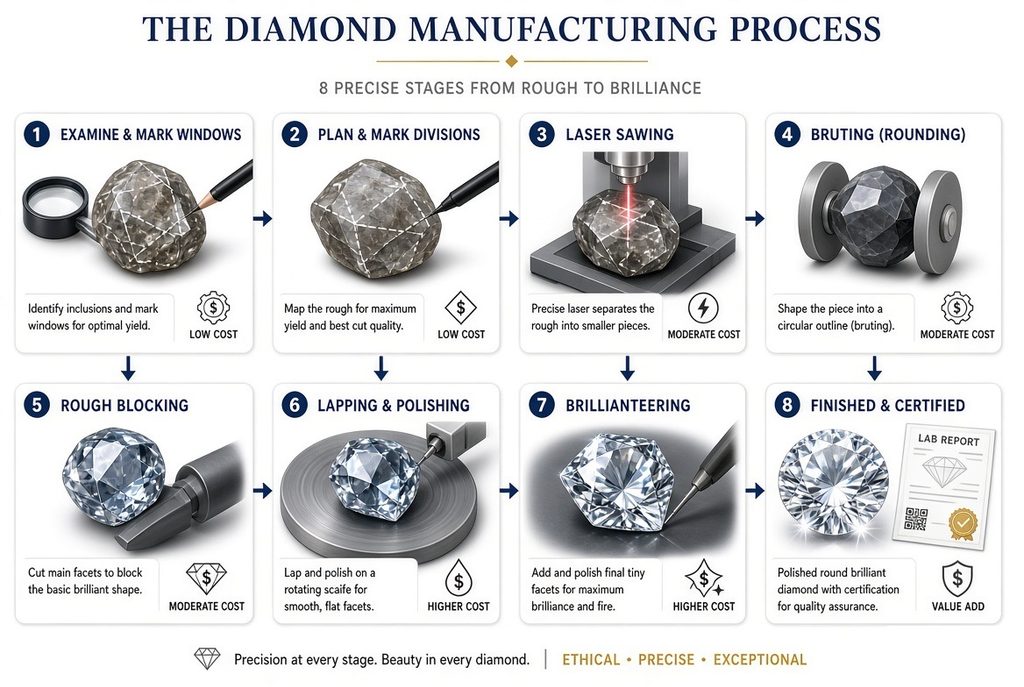
Diamond Manufacturing Process & Indicative Cost
| Stage | What happens | Indicative cost |
|---|---|---|
| 1. Marking for windows | The rough is examined and marked to expose windows, inclusions, colour and internal characteristics before deciding how to work the stone. | $20–$100+ |
| 2. Marking for division | The marker determines the best way to divide the rough to maximise value and yield. This is one of the most important decisions in manufacturing. | $30–$150+ |
| 3. Laser sawing | The rough is accurately sawn using a laser where required. Used to separate portions of rough while controlling yield and inclusions. | $50–$300+ per cut |
| 4. Cutting round | The rough is rounded/bruted into the basic circular outline required for a round brilliant. | $50–$250+ |
| 5. Rough blocking | The main facets are cut into the stone, establishing the basic proportions, symmetry and overall shape. | $100–$500+ |
| 6. Lapping | The stone is polished against a rotating wheel to produce the required facets and remove remaining cutting marks. | $100–$400+ |
| 7. Brillianteering | The final smaller facets are polished, bringing the diamond to its finished brilliance, symmetry and surface quality. | $100–$500+ |
| 8. Certification | The finished diamond is submitted to a recognised laboratory for grading and reporting. | $150–$300+ |
A simple example
For a small-to-medium round brilliant, the manufacturing cost might broadly fall around:
$600–$2,500+ per finished diamond, excluding the cost of the rough diamond.
For larger, more valuable or technically difficult stones, manufacturing can be several thousand dollars or considerably more.
The important point is that the manufacturing cost is not necessarily proportional to the carat weight. A 2.00 ct diamond can require dramatically more skilled labour, time and risk than two 1.00 ct diamonds.
What each stage actually does
1. Marking for windows
This is where the marker begins to understand what is actually inside the rough.
The stone is examined for:
- inclusions
- fractures
- colour
- strain
- grain
- cleavage directions
- potential windows
- areas of better or poorer material
The marker may open or identify windows in the rough so that the internal characteristics can be properly assessed.
This is highly skilled work because the marker is effectively trying to see the finished diamond before it exists.
2. Marking for division
This is arguably one of the most commercially important stages.
The marker decides:
Where should the rough be divided?
The objective isn’t simply to obtain the largest possible polished diamond.
It is to determine the combination of diamonds that produces the highest overall value from the rough.
For example, one piece of rough might potentially produce:
- one 2.00 ct diamond
- two 1.00 ct diamonds
- a 1.30 ct + 0.70 ct combination
- or several smaller diamonds.
The best manufacturing decision depends on colour, clarity, shape, proportions and the market value of the resulting polished stones.
This is why experienced marking is so valuable.
3. Laser sawing
Once the division has been determined, laser sawing can be used to separate the rough.
Modern laser technology allows extremely accurate cutting while reducing some of the risks associated with traditional sawing.
The cost depends on:
- size of the rough
- complexity of the cut
- number of cuts
- thickness of the material removed
- required accuracy
- machine time.
For high-value rough, the laser cost itself can actually be relatively insignificant compared with the value of what could be lost through an incorrect decision.
4. Cutting Round
The sawn or divided piece is then shaped into the basic round outline.
Historically this was associated with bruting, where one diamond was used against another. Modern manufacturing can use sophisticated mechanical and laser-assisted equipment.
The objective is to establish:
diameter + roundness + girdle outline + maximum usable material.
At this stage, the cutter is still balancing yield against the proportions required for the final diamond.
5. Rough Blocking
Blocking establishes the fundamental geometry of the diamond.
The main facets are created, including the basic framework for:
- table
- crown
- pavilion
- culet area
- major facets
- overall symmetry.
This is where the diamond begins to look recognisably like a polished brilliant.
The blocker has to maintain enough material for subsequent polishing while establishing the correct proportions.
6. Lapping
Lapping is where the diamond is progressively polished on the wheel.
The cutter removes extremely small amounts of diamond to achieve the required:
- facet angles
- facet junctions
- proportions
- symmetry
- surface finish.
Diamond is exceptionally hard, but it is also directional in its cutting characteristics.
Knowing how the diamond will respond to the wheel is an important part of the cutter’s skill.
7. Brillianteering
Brillianteering is essentially the finishing stage.
The smaller facets are introduced and polished to complete the brilliant pattern.
This includes the final refinement of:
- star facets
- upper girdle facets
- lower girdle facets
- pavilion facets
- crown facets
- facet junctions
- polish
- symmetry.
At this point, fractions of a millimetre can make a meaningful difference to the finished diamond’s appearance and grading.
8. Certification
Once manufacturing is complete, the diamond can be submitted to a recognised laboratory.
The laboratory examines the finished stone and determines characteristics such as:
- carat weight
- colour
- clarity
- cut, where applicable
- polish
- symmetry
- fluorescence
- proportions
- identifying characteristics
- natural or laboratory-grown status.
The certification cost is therefore not really a manufacturing cost in the same sense as cutting and polishing. It is a separate professional laboratory expense associated with establishing and documenting the characteristics of the finished diamond.
The part most people underestimate
The biggest cost in diamond manufacturing isn’t necessarily the $50, $100 or $300 machine operation.
It is the loss of potential value through poor manufacturing decisions.
Imagine $100,000 worth of rough.
A highly experienced marker might determine that the best manufacturing plan produces $150,000 of polished diamonds.
A poor decision might produce $120,000.
The difference is $30,000, even though the actual cutting and polishing costs may only be a few thousand dollars.
That is why, traditionally, the marker has been one of the most important people in the entire diamond manufacturing process.
The marker isn’t simply deciding where to draw a line on a rough diamond. They are making a series of decisions that determine:
yield → size → colour → clarity → proportions → finished value.
And that is also why two manufacturers can receive the same piece of rough and produce very different commercial results.
Comments are closed