
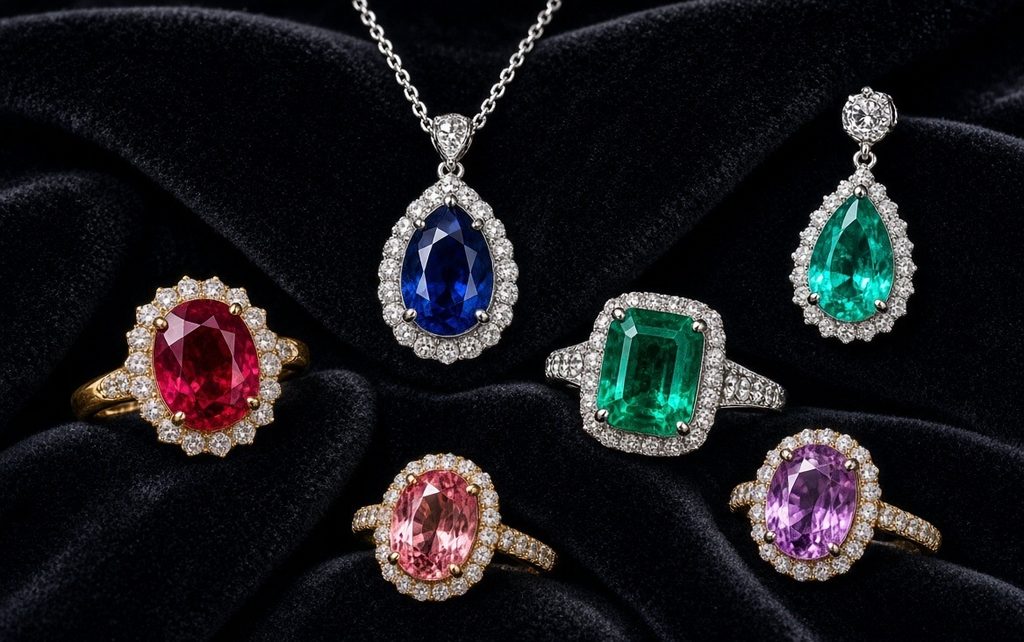
From magnificent Burmese rubies and Kashmir sapphires to Colombian emeralds and Paraíba tourmalines, coloured gemstones have captivated collectors, royalty and jewellery enthusiasts for centuries. Discover the world’s most important coloured gemstones, where they originate, how they are cut and treated, what makes them valuable, and how they can be damaged, restored and preserved.
The extraordinary world of coloured gemstones
Diamonds may traditionally dominate the fine jewellery market, but coloured gemstones occupy an equally fascinating world of beauty, geological rarity and exceptional value.
For thousands of years, rubies, sapphires, emeralds and other precious stones have been treasured by royalty, collectors and wealthy families. They have adorned crowns, royal jewellery, religious artefacts and some of the world’s most important private collections.
Unlike diamonds, where the traditional grading system focuses on the 4Cs of cut, colour, clarity and carat weight, coloured gemstones require a more individual approach. Their value is determined by a combination of colour, transparency, clarity, size, origin, treatment, rarity and overall beauty.
Two gemstones of identical weight and apparent colour can have dramatically different values depending on their geological origin, internal characteristics and whether they have undergone treatment.
Some exceptional untreated gemstones can command millions of dollars, while other stones of the same variety may be worth only a fraction of that amount.
Understanding these differences is essential when purchasing, selling, collecting or inheriting coloured gemstone jewellery.
1. The major types of coloured gemstones
The coloured gemstone market includes hundreds of different mineral varieties and organic gem materials. However, several major groups consistently attract the greatest attention from collectors and the international jewellery trade.
Ruby – The king of coloured gemstones
Ruby is one of the most desirable and valuable coloured gemstones in the world. It belongs to the corundum mineral family, the same mineral that produces sapphire.
Its red colour is primarily caused by chromium within its crystal structure.
The finest rubies display a rich, vivid red with strong saturation and an attractive balance of tone. The traditional trade description “pigeon’s blood” is associated with exceptional ruby colour, although terminology and laboratory requirements vary.
Important ruby origins include:
- Myanmar (Burma), particularly the historic Mogok deposits.
- Mozambique, which has become a major source of important modern rubies.
- Thailand, historically significant in the ruby trade.
- Sri Lanka, producing a variety of lighter red and pinkish-red stones.
- Madagascar, which produces rubies in several different qualities.
Myanmar rubies have historically attracted exceptional premiums, particularly fine stones with desirable colour and no evidence of heat treatment.
Mozambique has also produced some extraordinary large rubies, including stones that have achieved record auction prices.
Exceptional auction values
In June 2023, the 55.22-carat Estrela de Fura ruby, originating from Mozambique, sold at Sotheby’s New York for approximately US$34.8 million.
The sale established a remarkable auction record for a ruby and demonstrated the extraordinary demand for exceptional natural gemstones.
Source: Sotheby’s – The Estrela de FURA Ruby
Sapphire – More than just blue
Sapphire is another member of the corundum family.
Although blue sapphire is the most recognised variety, sapphires occur naturally in an extraordinary range of colours, including:
- Blue
- Pink
- Yellow
- Orange
- Green
- Purple
- Violet
- Colourless
- Padparadscha, a particularly rare pinkish-orange to orange-pink variety.
Some of the world’s most desirable blue sapphires originate from Kashmir, Myanmar and Sri Lanka.
Kashmir sapphires are particularly famous for their velvety blue appearance, often displaying a soft, slightly hazy quality that is highly prized by collectors.
Sri Lankan sapphires are known for their attractive range of blues and other colours, while Burmese sapphires can display exceptional saturation.
Australian sapphires, particularly those from Queensland and New South Wales, are also internationally recognised. They commonly occur in blue, green and yellow combinations, including the distinctive parti-coloured varieties.
Exceptional auction values
In May 2025, Christie’s Hong Kong sold the 35.09-carat Regent Kashmir sapphire for approximately US$9.5 million, representing around US$271,000 per carat.
Kashmir sapphires with exceptional colour, substantial size and confirmed unheated status are among the most desirable coloured gemstones in the international market.
Source: Christie’s – International Magnificent Jewels auctions.
Emerald – The beauty of natural green
Emerald is the green variety of beryl, with its colour primarily resulting from chromium and/or vanadium.
The finest emeralds display a rich, vibrant green with excellent saturation and attractive transparency.
Colombia is historically the most prestigious source of emeralds, particularly the deposits of Muzo, Chivor and Coscuez.
Other important origins include:
- Zambia
- Brazil
- Afghanistan
- Pakistan
- Ethiopia
- Zimbabwe.
Colombian emeralds are particularly desirable, although exceptional emeralds from Zambia and other origins can also command substantial prices.
Emeralds are famous for their internal characteristics, commonly described as jardin, the French word for garden.
These inclusions are a natural part of emerald formation and help give each stone its individual character. However, extensive fractures can affect transparency, durability and value.
Exceptional auction values
The 18.04-carat Rockefeller Emerald sold at Christie’s New York in 2017 for approximately US$5.5 million, or US$305,000 per carat.
It was particularly remarkable because it was documented as having no clarity enhancement.
Source: Christie’s – The Rockefeller Emerald
Spinel – An increasingly sought-after collector’s gemstone
Spinel has historically been confused with ruby, and some famous historic royal rubies have subsequently been identified as spinels.
It occurs in red, pink, purple, violet, blue and other colours.
Exceptional red spinels from Myanmar are particularly sought after, while vivid cobalt-blue spinels are highly desirable.
Important sources include Myanmar, Sri Lanka, Tanzania, Vietnam and Tajikistan.
Fine spinels can be exceptionally beautiful and are often naturally untreated, which adds to their appeal.
Tourmaline – An extraordinary range of colours
Tourmaline is one of the most colourful gemstone families.
It occurs in almost every colour, sometimes displaying several colours within the same crystal.
Important varieties include:
- Rubellite – pink to red tourmaline.
- Indicolite – blue tourmaline.
- Paraíba – vivid neon blue to green tourmaline.
- Verdelite – green tourmaline.
- Watermelon tourmaline – pink and green colour combinations.
Paraíba tourmalines are among the most sought-after modern coloured gemstones.
Their remarkable electric blue and green colours are associated with copper and manganese within the crystal structure.
The original Brazilian Paraíba deposits are particularly famous, although similar copper-bearing tourmalines have subsequently been discovered in Mozambique and Nigeria.
The finest Brazilian stones can attract extraordinary prices because of their exceptional colour and limited availability.
Other important coloured gemstones
Other varieties that deserve particular attention include:
Alexandrite: A rare variety of chrysoberyl famous for changing colour, typically appearing green or bluish-green in daylight and reddish or purplish under incandescent lighting. Fine Russian alexandrite is especially collectible, although important deposits also exist in Brazil, Sri Lanka and East Africa.
Tanzanite: A blue to violet variety of zoisite found commercially in only one known mining region near Mount Kilimanjaro in Tanzania. Its distinctive colour and restricted geographical source make it particularly interesting to collectors.
Aquamarine: A blue to blue-green variety of beryl. Important sources include Brazil, Madagascar, Pakistan and Mozambique. Large, clean aquamarines can be particularly attractive.
Garnet: A diverse mineral group including tsavorite, demantoid, rhodolite, spessartine and almandine. Fine green tsavorite and demantoid garnets can be especially desirable.
Opal: Australia is internationally famous for its precious opals, particularly Lightning Ridge black opal, Coober Pedy white opal and Queensland boulder opal. Fine black opals displaying vivid play-of-colour can be extremely valuable.
Topaz: Available in several colours, including blue, yellow, pink and the rare imperial topaz. Much commercial blue topaz is treated.
2. Gemstone shapes and cutting styles
The way a gemstone is cut has a major influence on its appearance, brilliance, colour distribution and overall value.
Unlike diamonds, where brilliant cutting is designed primarily to maximise light return, coloured gemstones are often cut to enhance their natural colour and minimise the visibility of inclusions.
The cutter must balance beauty, weight retention and the natural characteristics of the rough crystal.
The most common shapes include:
Oval: One of the most popular shapes for rubies, sapphires and emeralds. Its elongated outline provides an attractive balance between size and colour presentation.
Round: A classic symmetrical shape used for many varieties of coloured gemstones. Round cutting can maximise brilliance, although it may require sacrificing more rough material.
Cushion: A square or rectangular shape with rounded corners. Particularly popular for rubies, sapphires and emeralds, especially in traditional fine jewellery.
Emerald cut: A rectangular or square step-cut design featuring broad, flat facets. It is especially popular for emeralds, although the style is also used for sapphires and other gemstones.
Pear: A teardrop-shaped design frequently used in pendants and earrings.
Marquise: An elongated shape with pointed ends, designed to maximise apparent size and create an elegant appearance.
Heart: A specialised cut often used for sentimental and decorative jewellery.
Cabochon: A smooth, rounded surface without traditional facets. This cut is particularly suitable for opaque gemstones, star sapphires, star rubies and certain opals.
Rose cut: A historic cutting style featuring a domed upper surface with triangular facets. It is used in some antique and contemporary coloured gemstone jewellery.
Sugarloaf: A high-domed, square or rounded cabochon, particularly associated with important emeralds and other translucent gemstones.
Some gemstones display optical phenomena that require specialised cutting.
Star sapphires and rubies, for example, are cut as cabochons to display a star-shaped optical effect known as asterism. Cat’s-eye gemstones are also cut to display a distinct band of reflected light.
3. Treatments and enhancements – What buyers need to understand
One of the most important factors influencing coloured gemstone value is whether the stone has been treated.
Many gemstones undergo treatments to improve their colour, transparency or apparent clarity.
Some treatments are widely accepted within the jewellery industry, provided they are properly disclosed. Others can have a significant impact on value, durability and long-term desirability.
The absence of treatment can make an exceptional gemstone considerably rarer and more valuable.
Heat treatment
Heat treatment is one of the most common gemstone enhancements.
Controlled heating can improve or alter the colour and clarity of certain gemstones.
It is frequently used for:
- Rubies
- Blue sapphires
- Yellow sapphires
- Aquamarines
- Tanzanite
- Some tourmalines and other gem materials.
In sapphire, heat treatment can improve colour saturation and alter the appearance of internal inclusions.
In aquamarine, heating can reduce greenish colour components and produce a more attractive blue.
Heat treatment can be permanent, but its effect on value depends on the gemstone, the quality achieved and market expectations.
Oil and resin treatment
Emeralds frequently contain natural fractures and fissures.
To improve their apparent clarity, these openings may be filled with oils, resins, waxes or other substances.
Traditional cedarwood oil has long been used in emerald treatment.
Modern treatments can include synthetic resins and polymers.
The amount of filler is important. Minor traditional oiling and substantial resin filling should not be treated as equivalent.
The type, quantity and stability of the filler can have a significant effect on value.
Glass filling
Some rubies are subjected to lead-glass filling, a treatment that reduces the visibility of fractures and makes heavily included material appear more transparent.
This can substantially improve the appearance of a low-quality ruby.
However, the stone is still fractured internally, and the glass filler can be vulnerable to heat, chemicals and certain cleaning processes.
Glass-filled rubies should never be valued as equivalent to fine natural rubies of comparable appearance.
Diffusion treatment
Diffusion involves introducing colouring elements into the gemstone’s crystal structure through high-temperature processing.
It is particularly associated with sapphire and ruby.
Beryllium diffusion, for example, can alter the colour of corundum and produce attractive colours that may otherwise be difficult to achieve.
Some diffusion treatments penetrate only the surface, while others can extend much further into the stone.
The treatment must be identified and disclosed because it can substantially affect market value.
Irradiation
Irradiation uses controlled exposure to radiation to change the colour of certain gemstones.
It is commonly associated with blue topaz and can also be used on other gem materials.
Some irradiated colours are stable, while others may be affected by light or heat.
Dyeing and surface coating
Dyeing is used to introduce or intensify colour in porous or fractured materials.
It is encountered in materials such as chalcedony, turquoise, pearls and some other gemstones.
Surface coatings can also be applied to change the apparent colour or appearance of a gemstone.
These treatments require careful examination and disclosure.
For further information, see GIA’s comprehensive guide:
GIA – An Introduction to Gem Treatments
4. Geographic origin – Why the source matters
The geographic origin of a coloured gemstone can have a substantial influence on its market value.
Certain mining regions have developed international reputations for producing stones with distinctive characteristics.
For example:
- Myanmar is historically famous for exceptional rubies and spinels.
- Kashmir is renowned for fine blue sapphires.
- Colombia is famous for high-quality emeralds.
- Brazil is an important source of Paraíba tourmaline, aquamarine and alexandrite.
- Sri Lanka produces sapphires, spinels, garnets and other gemstones.
- Zambia is an important source of emeralds.
- Mozambique is a significant source of rubies and tourmalines.
- Tanzania produces tanzanite, tsavorite and spinel.
- Australia is internationally recognised for black opals, boulder opals and sapphires.
However, an important distinction must be made between identifying a gemstone and determining its geographic origin.
A laboratory may be able to identify a natural ruby, sapphire or emerald and determine whether it has undergone treatment.
Determining its geographic origin is a more specialised scientific process.
Gemologists examine inclusions, trace elements, growth structures and other characteristics to assess whether a gemstone is consistent with a particular geological source.
Even with advanced analytical equipment, origin determination is not always possible, and some results may be inconclusive.
An origin opinion is not automatically available for every gemstone, and not every stone from a famous locality is necessarily valuable.
The quality of the individual gemstone remains fundamental.
Further reading:
5. What makes a coloured gemstone valuable?
There is no single universal grading system for all coloured gemstones.
Their value is determined by several interconnected factors.
Colour: Generally the most important consideration. Fine gemstones display attractive hue, tone and saturation. A vivid, well-balanced colour is often more desirable than a stone that is excessively dark, pale or uneven.
Clarity: The visibility, number, size and position of internal inclusions influence transparency and beauty. Some inclusions are accepted as characteristic of a particular gemstone, particularly emeralds.
Carat weight: Larger gemstones of exceptional quality are significantly rarer than smaller stones. Prices can increase dramatically as size increases.
Cut: A well-proportioned cut should maximise the gemstone’s colour, brilliance and overall appearance while minimising unnecessary weight loss.
Origin: A prestigious and scientifically supported geographic origin can attract a substantial premium.
Treatment: Fine untreated gemstones are generally rarer and can command significant premiums over comparable treated material.
Rarity: Certain combinations of colour, size, clarity and origin occur extremely infrequently.
Documentation and provenance: Independent laboratory reports, historical records and documented ownership can contribute to buyer confidence and desirability.
6. The extraordinary prices achieved by the world’s rarest gemstones
The international auction market demonstrates just how valuable exceptional coloured gemstones can become.
The following examples illustrate the upper end of the market. They are individual auction results, not representative retail prices or standard valuation benchmarks.
| Gemstone | Exceptional example | Auction result |
|---|---|---|
| Ruby | 55.22 ct Estrela de Fura, Mozambique, 2023 | US$34.8 million |
| Sapphire | 35.09 ct Regent Kashmir, 2025 | Approximately US$9.5 million |
| Emerald | 37 ct Aga Khan Emerald, 2024 | Approximately US$8.86 million |
| Emerald | 18.04 ct Rockefeller Emerald, 2017 | US$5.51 million |
The prices achieved by these gemstones demonstrate the extraordinary premiums attached to exceptional colour, size, provenance and rarity.
Sources: Sotheby’s and Christie’s auction records.
It is important to understand that these prices represent the very top of the international market.
A commercially available ruby, sapphire or emerald may sell for a small fraction of these figures.
Even within the same geographic origin, two gemstones can have substantially different values because of their colour, clarity, treatment and overall quality.
7. How coloured gemstones become damaged
Although many coloured gemstones are exceptionally hard, they are not indestructible.
Their ability to withstand everyday wear depends on more than their position on the Mohs hardness scale.
Hardness measures resistance to scratching, while toughness relates to resistance to breaking, chipping and fracturing.
A gemstone may be hard but still relatively brittle.
Common forms of damage include:
Chipping: Small pieces of gemstone material break away, often around the edges, corners or girdle.
Fractures: Internal cracks can develop following an impact or excessive pressure.
Abrasion: Repeated contact with other jewellery or abrasive materials can wear down facet edges and polish.
Scratches: Softer gemstones can develop surface scratches through everyday handling.
Cleavage: Some gemstones have natural planes of weakness along which they can split.
Heat damage: Excessive heat can cause fractures, alter colour or damage existing treatments and filling materials.
Chemical damage: Certain cleaning products, solvents and household chemicals can affect gemstones, particularly those with oils, resins, coatings or organic structures.
Different gemstones have different vulnerabilities.
Rubies and sapphires are relatively durable, with a Mohs hardness of 9.
Emeralds are reasonably hard but can be vulnerable to impact because of their natural fractures.
Tanzanite has distinct cleavage and requires careful handling.
Opals are relatively soft and can be vulnerable to scratching, thermal shock and cracking.
Pearls are particularly delicate and can lose their lustre through abrasion, chemicals and unsuitable cleaning.
8. Can damaged coloured gemstones be repaired?
In many cases, yes. However, the appropriate repair depends on the type of gemstone, the nature of the damage and the value of the stone.
Unlike diamonds, where repolishing or recutting can sometimes restore a damaged stone, coloured gemstones require a more individual assessment.
The objective is to restore the appearance and usability of the gemstone while retaining as much original material and value as possible.
Repolishing
Minor surface scratches and abrasions may be removed through careful repolishing.
This involves removing a very small amount of material to restore a smooth surface and improve the gemstone’s appearance.
The process must be carefully controlled because excessive polishing can alter the proportions and reduce the carat weight.
Recutting
Where a gemstone has suffered a more substantial chip or fracture, recutting may be necessary.
A skilled gemstone cutter examines the damaged area and determines whether material can be removed to produce a new, attractive shape.
This may involve changing an oval into a cushion, altering the proportions of an emerald cut or reducing the overall dimensions of the stone.
The objective is not necessarily to retain the original weight but to achieve the best possible finished gemstone.
Replacing a damaged gemstone
Sometimes the damage is too extensive for an economically sensible repair.
In these circumstances, replacing the gemstone may be the most practical option, particularly when it is part of an important piece of jewellery.
The original stone may still have value as a collector’s specimen, or it may be possible to recover some of its material through specialist cutting.
Repairing fracture-filled gemstones
Particular care is necessary when dealing with emeralds and rubies that have undergone clarity enhancement.
Heat, solvents, chemicals and some jewellery repair processes can damage or remove the filling material.
A stone that appears to have developed new fractures may actually have experienced deterioration or loss of its original filler.
It is therefore important to identify any existing treatment before attempting restoration.
Replacing settings and protecting vulnerable gemstones
Not all gemstone damage requires work on the gemstone itself.
Sometimes the jewellery setting is responsible for exposing a vulnerable edge or corner to repeated impacts.
A protective bezel setting, appropriately designed claws or a redesigned mounting can help reduce the likelihood of further damage.
Before resetting an important gemstone, it should be examined by an experienced jeweller or gemologist.
9. Caring for coloured gemstones
Correct care and maintenance can significantly extend the life of coloured gemstone jewellery.
However, there is no universal cleaning method suitable for every gemstone.
Some general recommendations include:
- Avoid wearing delicate gemstones during heavy physical activity.
- Store gemstones separately to prevent harder stones from scratching softer ones.
- Avoid household chemicals, bleach and abrasive cleaning products.
- Do not assume ultrasonic or steam cleaning is safe.
- Have emeralds and other treated stones inspected before professional cleaning.
- Remove jewellery before swimming, exercising or undertaking manual work.
- Have settings and claws inspected regularly.
- Seek professional advice before attempting to repair a chipped or fractured gemstone.
For pearls, opals, emeralds and tanzanite, additional precautions are particularly important.
A little preventative care can avoid unnecessary damage and costly restoration.
10. The importance of professional gemstone identification
The coloured gemstone market is complex.
Natural gemstones, laboratory-grown gemstones, simulants and treated materials can sometimes look remarkably similar to the unaided eye.
A visually attractive gemstone does not automatically reveal its identity, origin or treatment history.
Professional gemmological examination can help establish what a gemstone actually is and identify characteristics that may significantly influence its value.
Depending on the gemstone and the examination required, testing may involve:
- Microscopic examination.
- Refractive index testing.
- Specific gravity measurements.
- Spectroscopic analysis.
- Ultraviolet fluorescence.
- Examination of inclusions and growth structures.
- Advanced analytical testing where necessary.
It is particularly important to distinguish between natural and laboratory-grown gemstones.
A laboratory-grown ruby or sapphire may have essentially the same chemical composition and crystal structure as its natural counterpart, but its market value and rarity are very different.
Similarly, identifying a gemstone as natural does not automatically establish that it is untreated.
These are separate questions requiring appropriate examination.
The DCLA perspective: Knowledge, identification and confidence
Coloured gemstones represent one of the most fascinating areas of gemmology.
Every stone has its own geological history, internal characteristics and physical properties. Understanding those characteristics is essential when buying, selling, inheriting or restoring fine gemstone jewellery.
At DCLA, we believe that understanding a gemstone begins with establishing exactly what it is.
Independent gemmological knowledge, careful examination and appropriate documentation are important safeguards in a market where appearance alone can be misleading.
Whether you own an important ruby, an inherited emerald, a valuable sapphire or an unusual coloured gemstone, obtaining reliable identification and understanding its treatments and condition can help you make informed decisions.
For further information, explore the DCLA educational resources:
- DCLA – Gemmology: The Science, Art and Profession of Evaluating Gemstones
- DCLA – Our Laboratory
- DCLA – Coloured Gemstones and Pearls: Understanding Durability
- DCLA – Diamond and Jewellery Setting Styles
For additional scientific information, GIA provides extensive independent research into gemstone identification, treatments, origin determination and care.
Conclusion
The world of coloured gemstones is far more complex than simply choosing a beautiful colour.
Behind every exceptional ruby, sapphire, emerald or tourmaline is a unique combination of geological conditions, chemical composition, crystal structure and natural rarity.
The finest stones can achieve extraordinary prices because nature has created something that cannot easily be replicated.
Understanding the gemstone, its origin, its treatments, its condition and its history is essential to appreciating its true significance.
Whether purchasing a first coloured gemstone or examining a rare collector’s piece, knowledge and independent gemmological assessment remain invaluable.
DCLA – Diamond Certification Laboratory of Australia
Independent gemmological knowledge, examination and confidence in the world of diamonds and gemstones.
Comments are closed