
There are rare diamonds. And then there are red diamonds.
So scarce that many gemologists, miners and collectors will go through their entire careers without ever seeing one in person.
Unlike yellow diamonds (coloured by nitrogen) or blue diamonds (coloured by boron), natural red diamonds contain no colour-causing impurities. Their intense colour comes from something far more extraordinary.
Deep beneath the Earth’s surface over billions of years, extreme tectonic forces subjected these diamonds to immense pressure. Instead of fracturing, their crystal lattice distorted. These microscopic structural changes alter the way light passes through the stone, producing the rare and highly prized red hue.
Nature did not add colour. It reshaped perfection.
The Art of Cutting
Every red diamond is treated as irreplaceable. Master cutters often spend months studying a single crystal before making the first cut. One poorly placed facet can permanently diminish the colour intensity that gives the stone its extraordinary value.
For this reason, many of the world’s finest red diamonds are cut into shapes that prioritise colour retention over maximum brilliance, including:
- Cushion Modified Brilliant
- Oval Brilliant
- Radiant
- Trillion
In each case, the cutter’s primary goal is to preserve the red colour.
The World’s Most Celebrated Red Diamond
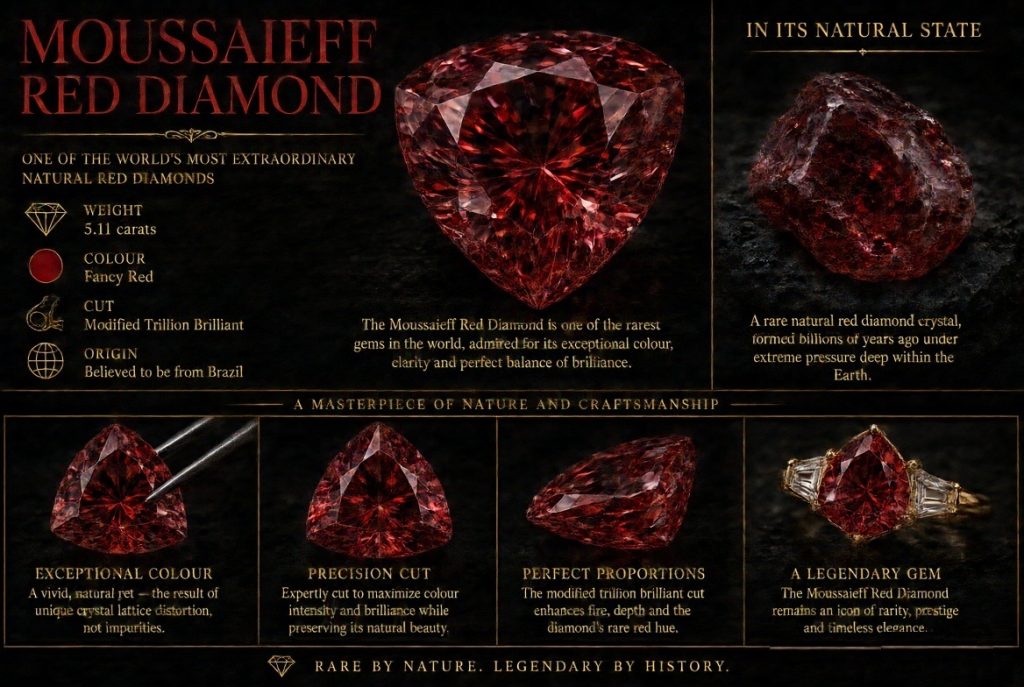
The Moussaieff Red remains the benchmark for natural red diamonds:
- Weight: 5.11 carats
- Colour: Fancy Red
- Cut: Modified Trillion Brilliant
- Origin: Believed to have been recovered in Brazil
Despite weighing just over five carats, it is considered one of the most valuable diamonds ever discovered purely because true natural red diamonds are exceptionally scarce.
Why Red Diamonds Captivate the World
Their worth is measured not only in carats, but in improbability.
The chance that carbon survives for billions of years… that pressure bends the crystal lattice without destroying it… and that the stone reaches the surface intact…
…is so vanishingly small that every natural red diamond stands as one of geology’s rarest triumphs.
Some diamonds are beautiful. Red diamonds are nearly impossible. And that is precisely why they continue to fascinate collectors and the jewellery world.
Comments are closed