
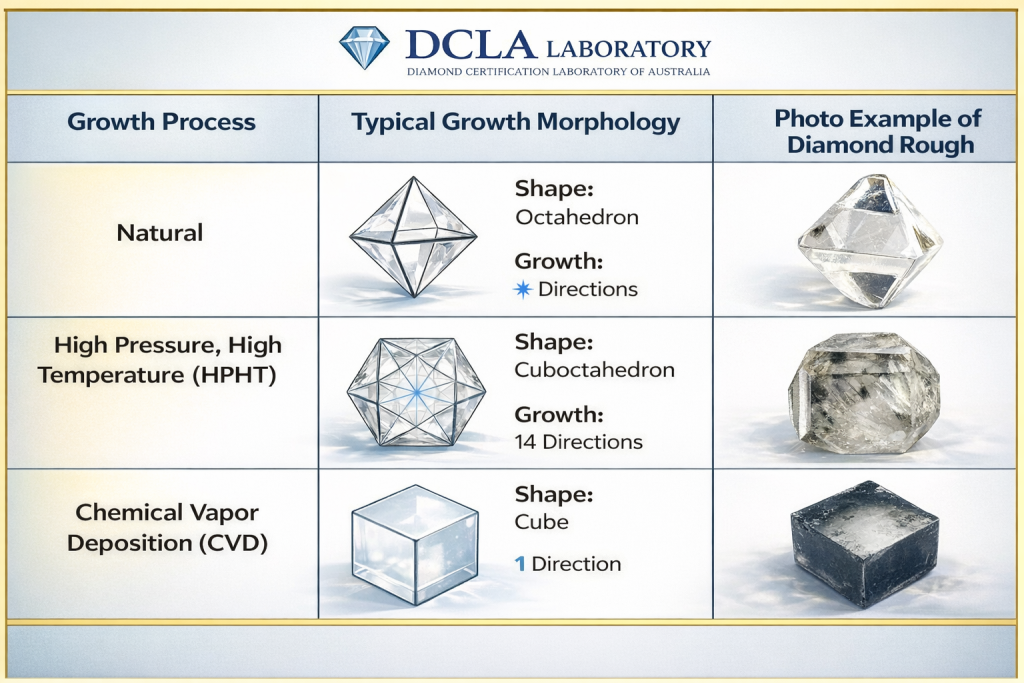
Diamonds, the ultimate symbol of beauty and resilience, are formed through processes that span millions of years—or, in the case of lab-grown stones, a matter of weeks. Understanding the growth processes of diamond rough—whether natural or synthetic—is essential for gemologists, investors, and enthusiasts alike. Natural diamonds, High-Pressure High-Temperature (HPHT) diamonds, and Chemical Vapor Deposition (CVD) diamonds each have distinct origins and growth mechanisms that influence their structure, quality, and value.
1. Natural Diamond Formation
Natural diamonds are formed deep within the Earth’s mantle, at depths of 140–190 kilometers, under extreme conditions of temperature (about 900–1,300°C) and pressure (45–60 kilobars). Carbon atoms are arranged in a rigid tetrahedral lattice over millions to billions of years, forming rough crystals that are later brought to the surface through volcanic eruptions in kimberlite or lamproite pipes.
The growth process is influenced by:
- Time and environment: Slow crystal formation over millions of years allows for the inclusion of trace elements like nitrogen, which can affect color.
- Crystal habit: Natural diamonds often develop octahedral or cubic shapes, with surface etchings, growth marks, or irregularities.
- Impurities and inclusions: The unique geological environment may embed other minerals or create structural irregularities, which can impact clarity and rarity.
Natural diamond growth is a marvel of geologic time, producing stones that are truly one-of-a-kind.
2. HPHT Diamond Growth
High-Pressure High-Temperature (HPHT) diamonds are lab-grown but mimic the conditions found deep in the Earth. The HPHT process was developed in the 1950s to replicate the mantle environment in a controlled laboratory setting.
Key aspects of HPHT growth include:
- Pressure and temperature: HPHT machines generate pressures above 50 kilobars and temperatures exceeding 1,400°C.
- Growth medium: A small seed diamond is placed in a carbon-rich metal solvent, such as iron, nickel, or cobalt. The carbon dissolves in the metal and gradually precipitates onto the seed crystal.
- Crystal formation: HPHT diamonds typically grow in an octahedral or cubic shape, often with metallic flux inclusions unique to the method.
- Applications: HPHT diamonds can be produced for industrial use, gem-quality stones, and even for colour enhancement of natural diamonds.
HPHT growth is faster than natural processes, producing gem-quality diamonds in a matter of days to weeks.
3. CVD Diamond Growth
Chemical Vapor Deposition (CVD) represents a different approach, creating diamonds layer by layer in a controlled gas environment. This method allows for precise control over size, purity, and even colour.
The CVD process involves:
- Gas mixture: Methane and hydrogen gases are introduced into a vacuum chamber.
- Plasma activation: Microwaves or hot filaments ionize the gases, creating a plasma that breaks down the carbon-containing molecules.
- Layered growth: Carbon atoms deposit onto a diamond seed plate, forming thin layers that gradually build a rough diamond crystal.
- Quality control: Temperature and gas composition can be fine-tuned to minimize defects and produce large, high-quality gem diamonds.
CVD diamonds often grow in plate-like or tabular formations. Post-growth treatments may be used to remove structural stress or enhance colour.
Comparing the Growth Processes
| Feature | Natural Diamonds | HPHT Diamonds | CVD Diamonds |
|---|---|---|---|
| Origin | Earth’s mantle | Lab, high pressure & temperature | Lab, gas plasma deposition |
| Timeframe | Millions to billions of years | Days to weeks | Weeks |
| Typical Shape | Octahedral, cubic | Octahedral, cubic | Tabular, layered |
| Impurities | Mineral inclusions, nitrogen | Metal flux inclusions | Gas-related defects |
| Colour & Clarity Control | Limited | Moderate, some control | High, precise control |
Understanding diamond rough growth processes is more than a technical curiosity it informs valuation, quality assessment, and sourcing decisions. Natural diamonds carry the story of Earth’s deep history, while HPHT and CVD diamonds showcase the remarkable capabilities of modern technology to replicate, enhance, and even innovate on nature’s blueprint. Whether you are a collector, jeweller, or investor, knowing how a diamond is formed is essential to appreciating its true worth.
Comments are closed