
Blue fluorescence, crystal structure, growth patterns and microscopic features can all help gemologists distinguish natural diamonds from laboratory-grown diamonds. But no single characteristic provides a definitive answer. Accurate identification requires a combination of observations, specialist equipment and advanced gemological testing.
Natural diamonds are remarkable geological products. Formed deep within the Earth over millions or billions of years, they carry physical and chemical characteristics that reflect the conditions under which they grew. Laboratory-grown diamonds share essentially the same chemical composition and crystal structure, but their different growth environments can leave identifiable differences.
Understanding these differences is increasingly important for jewellers, diamond dealers, valuers and consumers, particularly as laboratory-grown diamonds become more widespread in the jewellery market.
Blue fluorescence: An important clue, but not proof of natural origin
One of the best-known characteristics of natural diamonds is fluorescence, particularly the blue fluorescence that some diamonds display when exposed to ultraviolet (UV) light.
Fluorescence occurs when a diamond absorbs ultraviolet radiation and emits visible light. According to the Gemological Institute of America (GIA), approximately 25% to 35% of diamonds submitted to its laboratory over a decade exhibited some degree of fluorescence. Of those that fluoresce, blue is by far the most common colour.
Blue fluorescence can be associated with particular atomic defects within the diamond’s crystal structure, including nitrogen-related defects. In certain diamonds, boron impurities are also important, especially in blue, boron-bearing diamonds known as Type IIb.
However, it is essential to distinguish between two different observations: a diamond that fluoresces blue under a UV lamp and a diamond whose blue fluorescence is associated with boron. These are not interchangeable findings. Blue fluorescence alone does not prove that boron is present, nor does it establish that a diamond was mined.
GIA research has also documented boron-bearing laboratory-grown diamonds. Boron can be deliberately introduced during laboratory growth, and some laboratory-grown diamonds contain detectable boron. Therefore, the claim that boron has never been replicated in laboratory-grown diamonds is not supported by the published evidence.
What matters is the complete fluorescence response, the pattern of the reaction, the diamond’s other identifying characteristics and, where necessary, the results of advanced spectroscopic testing.
For further reading, see the GIA’s explanation of diamond fluorescence and its research into laboratory-grown diamond identification.
The importance of a diamond’s natural growth history
A natural diamond develops under geological conditions that differ significantly from those used to produce diamonds in a laboratory. These differences can be reflected in several characteristics.
1. Fluorescence and phosphorescence
The colour, intensity and pattern of fluorescence can help indicate a diamond’s growth origin. Natural diamonds often show a stronger response to long-wave UV than to short-wave UV, whereas many HPHT-grown and CVD-grown diamonds display different responses. Some laboratory-grown diamonds also exhibit phosphorescence, meaning they continue to emit light after the UV source is switched off.
These are useful diagnostic clues, but exceptions occur in both natural and laboratory-grown diamonds. A simple UV lamp test is therefore a screening method, not a definitive identification test.
2. Internal inclusions and growth features
Natural diamonds can contain mineral inclusions and internal features formed during their geological history. Laboratory-grown diamonds may instead show characteristic metallic inclusions, growth structures or other features associated with the HPHT or CVD production process.
Neither origin is identified by the mere presence or absence of inclusions. Some natural diamonds are exceptionally clean, while some laboratory-grown diamonds contain inclusions that require specialist examination to interpret.
3. Crystal strain and growth patterns
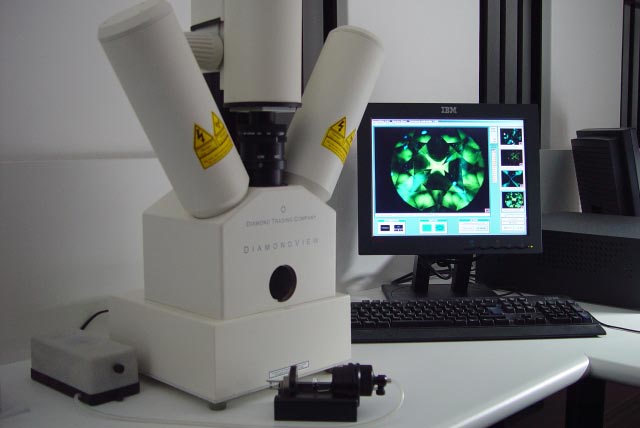
The way a diamond grew can leave distinctive internal strain patterns, colour zoning and fluorescence patterns. Certain laboratory-grown diamonds exhibit geometric or cross-shaped fluorescence patterns, while some CVD-grown diamonds show characteristic banding or striations.
Natural diamonds also display a range of growth and strain features. The diagnostic value lies in identifying the particular pattern and assessing whether it is consistent with natural formation or a laboratory growth process.
4. Spectroscopic characteristics
Advanced instruments can analyse the optical signatures associated with impurities and structural defects in a diamond. Techniques such as infrared absorption spectroscopy and photoluminescence spectroscopy can reveal characteristics that are not reliably identified through ordinary visual inspection.
These tests are especially important when a diamond’s appearance, fluorescence or internal features are inconclusive, unusual or inconsistent with its accompanying documentation.
Why basic screening can produce the wrong conclusion
Many diamond professionals rely on a combination of traditional gemmological observations and screening methods to decide whether a diamond requires further investigation. This is a sensible first step, but the reliability of the conclusion depends on the examiner’s training, the equipment available and the characteristics of the individual stone.
A diamond may display features commonly associated with natural origin and still be laboratory-grown. Equally, a natural diamond may display characteristics that initially raise suspicion.
For this reason, a basic UV lamp, jeweller’s loupe or conventional diamond tester should not be treated as sufficient evidence of natural origin.
The GIA explains that fluorescence patterns and other growth characteristics can help distinguish natural diamonds from laboratory-grown diamonds, but that multiple diagnostic features must be considered. Its research also documents unusual laboratory-grown diamonds and hybrid stones that require more advanced investigation.
You can read more in the GIA’s research on laboratory-grown diamond identification and its research update on laboratory-grown diamonds.
Why advanced gemmological equipment matters
At the Diamond Certification Laboratory of Australia (DCLA), identifying a diamond’s origin is not simply a matter of checking whether it reacts to a basic diamond tester.
DCLA’s published diamond grading process describes the use of specialist equipment and systematic examination to assess diamond origin, treatments and quality characteristics.
Its laboratory facilities include DiamondView™ fluorescence imaging, DiamondSure® screening technology and high-precision microscopic examination. These tools help gemmologists investigate growth structures, fluorescence patterns and other features that cannot be assessed reliably through ordinary visual inspection alone.
The distinction between screening and identification is important. A screening instrument can rapidly identify stones that appear consistent with natural diamonds or flag stones requiring additional testing. An inconclusive result does not automatically mean a diamond is laboratory-grown, and a screening result should be interpreted within the limitations of the technology.
For further background, see DCLA’s explanation of laboratory-grown diamond identification and its article on natural versus laboratory-grown diamonds.
What do GIA and HRD Antwerp say?
The importance of professional identification is recognised by major international gemmological laboratories.
The Gemological Institute of America (GIA) documents the distinctive growth features that may be observed in HPHT-grown and CVD-grown diamonds, including differences in fluorescence, colour distribution, strain patterns and inclusions.
HRD Antwerp also describes a formal examination process that begins by determining whether a diamond is natural, laboratory-grown or treated. Stones that do not pass the initial screening are referred for further investigation.
Both approaches underline a fundamental point: reliable identification is based on a structured examination process, not on one isolated characteristic.
A diamond report is only as reliable as the examination behind it
Consumers often assume that any valuation or diamond report automatically confirms that a stone is natural. That assumption can be misplaced.
A valuation primarily addresses monetary value for a stated purpose. A grading report describes a diamond’s characteristics, and an identification report may specifically address its natural or laboratory-grown origin. These documents serve different purposes.
When purchasing a significant diamond, inheriting jewellery or obtaining a valuation for insurance or resale, it is important to understand precisely what the document confirms and whether the diamond’s origin has been independently established.
A report should also correspond to the actual stone being examined. Report numbers, inscriptions and recorded characteristics can help establish that connection, but they must be checked rather than simply accepted at face value.
The bottom line: Look beyond the fluorescence
Blue fluorescence is an interesting and potentially useful part of a diamond’s identity. Boron is an important impurity in certain diamonds, and fluorescence, phosphorescence, inclusions, crystal strain and growth patterns can all provide valuable information about how a diamond formed.
But none of these characteristics should be considered in isolation.
The scientifically defensible conclusion is that natural and laboratory-grown diamonds can often be distinguished through a combination of advanced screening, microscopic examination and laboratory analysis. Some stones require more extensive testing than others, and even sophisticated screening methods have limitations.
For consumers, jewellers and valuers, the safest approach is to seek independent verification from a suitably equipped and experienced gemmological laboratory whenever natural origin is important.
At DCLA, our position is straightforward: a diamond should be identified by the evidence, not by assumption.
When the difference between a natural diamond and a laboratory-grown diamond matters, professional examination is not an unnecessary extra. It is an essential part of establishing what the stone actually is.
Further reading and references
- DCLA — Our Laboratory and Advanced Testing Technology
- DCLA — Diamond Grading Technology and Process
- DCLA — Fluorescence in Diamonds
- DCLA — Laboratory-Grown Diamond Identification
- GIA — Understanding Diamond Fluorescence
- GIA — How to Identify HPHT and CVD Laboratory-Grown Diamonds
- GIA — Laboratory-Grown Diamonds: Research Update
- HRD Antwerp — Natural Diamond Identification Report
- HRD Antwerp — Natural Diamond Grading Report
Comments are closed