
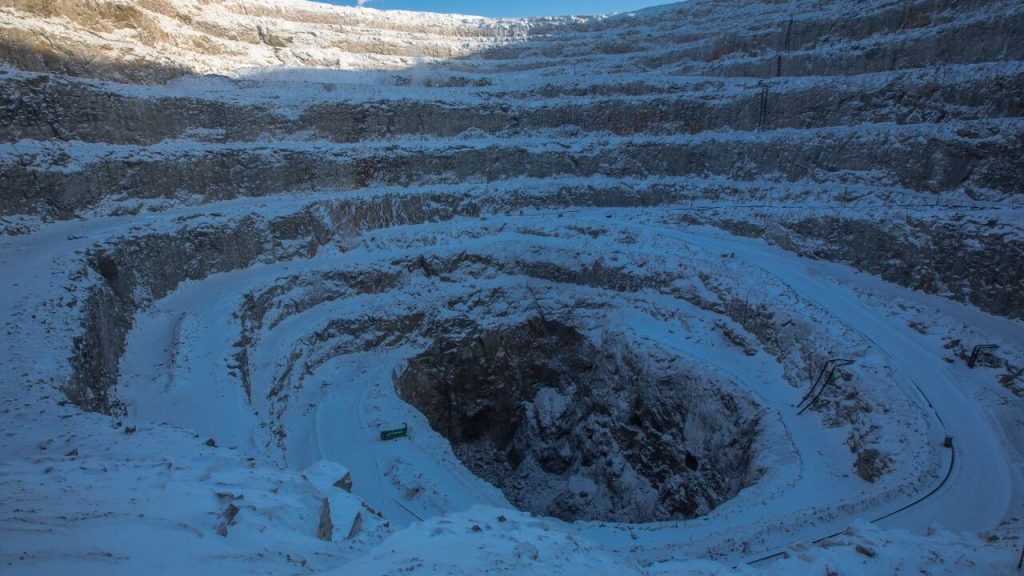
Rio Tinto has officially extracted the last diamond from its Diavik mine in Canada’s Northwest Territories, bringing to a close more than two decades of production and signalling the company’s exit from the diamond sector. The milestone reflects a strategic shift by the global mining giant toward core commodities such as copper and iron ore.
Over its 23 year lifespan, Diavik produced in excess of 150 million carats of rough diamonds, establishing itself as one of Canada’s most significant diamond operations. With economically recoverable reserves now fully depleted, the mine has ceased production, concluding a chapter that began in 2003.
Situated beneath Lac de Gras, approximately 220 kilometres south of the Arctic Circle, Diavik was discovered in 1991 and developed into a world-class operation. The mine exploited four kimberlite pipes through a combination of open pit and underground mining methods, yielding predominantly high-quality white diamonds alongside a smaller proportion of rare yellow stones.
The closure was marked by a formal ceremony attended by Indigenous representatives, government officials, and key stakeholders, highlighting the longstanding partnerships that underpinned the mine’s success. Diavik has been widely recognised as a model of collaboration between industry and Indigenous communities, delivering sustained economic and social benefits to the region.
Despite the end of mining activities, Rio Tinto will continue to process, polish, and distribute the remaining production through its global sales network, including its Select Diamantaires, into 2026 and beyond.
The closure comes at a challenging time for the Northwest Territories’ diamond sector. Operations at the Ekati mine were curtailed last year amid increased competition from lab grown diamonds and softer global pricing, while the Gahcho Kué mine remains in operation with a projected life extending to 2030.
Planning for Diavik’s closure had been integrated from the outset, and rehabilitation efforts will now accelerate. Site reclamation is expected to continue through to 2029, followed by a structured period of environmental monitoring to ensure long term sustainability and land restoration.
The end of Diavik is more than the closure of a mine. It represents the conclusion of one of Canada’s most important diamond producing assets and a notable moment in the evolution of the global diamond industry.
Comments are closed