
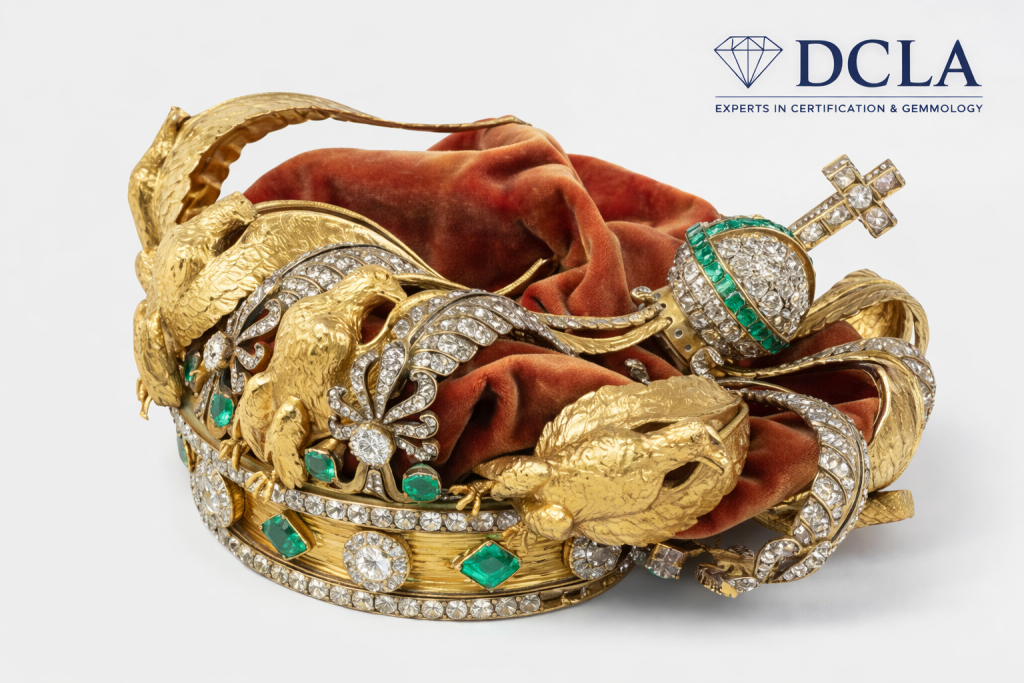
The Louvre Museum has released striking images of a historic crown once worn by Empress Eugénie, following its dramatic recovery after a high-profile jewellery heist at the Paris landmark. The crown, abandoned by thieves during their escape, was discovered crushed and badly deformed—but remarkably, largely intact.
The jewel-encrusted crown forms part of France’s imperial heritage and dates back to the Second French Empire (1852–1870), when Eugénie de Montijo reigned alongside her husband, Emperor Napoleon III. A noted style icon of her era, Empress Eugénie was instrumental in reviving court jewellery traditions inspired by earlier monarchies, commissioning elaborate pieces that blended imperial symbolism with exceptional gemstone craftsmanship.
The crown itself is a masterwork of 19th-century high jewellery, adorned with 56 emeralds and more than 1,350 diamonds, and originally surmounted by eight golden eagles—a powerful imperial emblem echoing Napoleonic authority. Such pieces were not merely ornamental; they were statements of political power, wealth, and France’s dominance in the decorative arts.
During the robbery in October last year, thieves escaped with an estimated €88 million worth of jewels, but were forced to abandon the crown after attempting to remove it through a narrow opening cut into the display case. This crude extraction caused significant deformation, flattening and damaging the metal structure. Despite this, the Louvre has confirmed that the crown retains all of its emeralds and all but ten of its diamonds. One golden eagle remains missing.
Crucially, museum experts report that the crown is “nearly intact” and can be restored without the need for reconstruction, preserving its original materials and craftsmanship. An expert restoration committee, led by Louvre president Laurence des Cars, has been appointed to oversee the delicate conservation process—an effort that will rely heavily on historical jewellery-making techniques and forensic gem analysis.
The heist also involved the theft of eight additional jewels, including a diamond tiara belonging to Eugénie. While investigations continue, the fate of the remaining pieces remains unknown.
For gemologists and historians alike, the incident underscores both the vulnerability and resilience of historic jewellery. Beyond its dramatic recovery, the crown of Empress Eugénie stands as a rare surviving example of imperial French jewellery—an object whose value lies not only in its diamonds and emeralds, but in its irreplaceable cultural and historical significance.
At DCLA, such cases highlight the importance of expert gemstone documentation, certification, and conservation, ensuring that historic jewels can be accurately studied, restored, and preserved for future generations.
Comments are closed