6.17-ct Fancy Pink could Fetch $1.8m

6.17-ct Fancy Pink

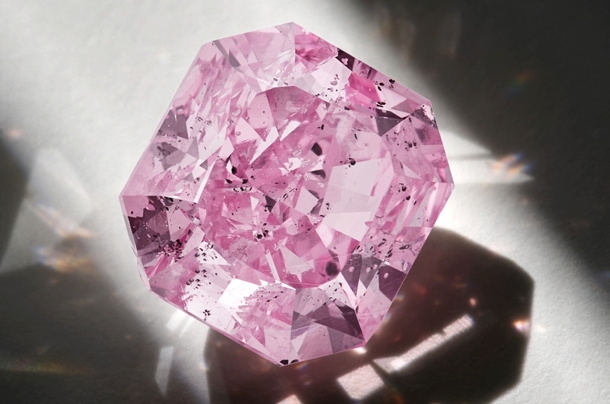
A 6.17-carat fancy pink diamond is expected to fetch up to $1.8m in an online auction.
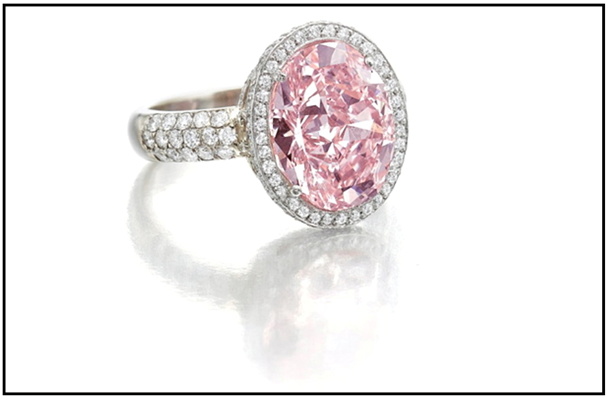
The Angelina belonged to Willa Dean Lyon, wife of Maj Gen William Lyon, and was named after their granddaughter.

Maj Gen Lyon was a successful businessman and real estate magnate from Southern California who built over 100,000 homes across the US. He died in 2020, aged 97. His wife died last year, aged 92.

The VVS2 oval modified brilliant diamond is set in an 18k white and rose gold ring, with about 1.00-cts of near-colorless diamonds.

It is being sold by Heritage Auctions, based in Dallas, as part of its Holiday Fine Jewelry Signature Auction, which closes on 3 December. The estimate is $1.2m to $1.8m.

According to the Fancy Color Research Foundation (FCRF), fancy pinks have appreciated by roughly 116 per cent over the past decade, outpacing all other fancy color categories for their investment potential.

Source: IDEX

6.95-Carat Pink Diamond to Headline Vanderbilt Family Jewels Auction in Geneva

fancy vivid purplish pink diamond

A spectacular 6.95-carat fancy vivid purplish pink Golconda diamond will lead The Geneva Jewels Auction: V, as Phillips Geneva prepares to offer an extraordinary collection of jewels once owned by the legendary Vanderbilt family, once America’s richest dynasty.

Among the highlights is a Tiffany & Co. 42.68-carat sugarloaf Kashmir sapphire and diamond brooch, estimated at US$1 million to US$1.5 million, alongside a step-cut Kashmir sapphire and diamond ring weighing 18.09 carats (estimate US$2.2 million to US$2.8 million). The sale also features a stunning pair of brilliant-cut diamond ear studs, weighing 8.00 and 8.28 carats, both graded D colour, VVS1 clarity, with an estimate of US$600,000 to US$850,000.

The Vanderbilt name is synonymous with immense wealth and American industrial power. The family’s fortune began with Cornelius Vanderbilt, who, at age 16, borrowed $100 from his mother to start a ferry service in 1810. He later built a shipping and railroad empire that made him the richest man in the United States, worth about $100 million at his death in 1877 — equivalent to at least $185 billion today.

His son, William Henry Vanderbilt, further doubled that fortune to over $200 million (around $370 billion in today’s terms). However, the family’s wealth gradually dispersed over subsequent generations, with the combined net worth of the Vanderbilt descendants now estimated at around $200 million.

The Geneva Jewels Auction: V, featuring The Vanderbilt Family Jewels, will take place on 10 November at Phillips Geneva, marking a rare opportunity for collectors to acquire pieces linked to one of America’s most storied families.

The Kao Legend Collection: A Rare Suite of Pink Diamonds from Lesotho

A Rare Suite of Pink Diamonds from Lesotho

The Kao Legend Collection represents an extraordinary achievement in diamond cutting and curation. Cut from a single 108.39-carat pink diamond crystal unearthed at the renowned Kao Mine in Lesotho, this suite features seven magnificent pink diamonds each documented in detail by the GIA Monograph.

At the heart of the collection lies the Kao Legend, a 20.49-carat diamond graded Fancy Intense Purplish Pink by the Gemological Institute of America (GIA). The accompanying diamonds in the collection range in colour from Fancy Intense Purplish Pink to Faint Pink, showcasing a delicate and rare spectrum of pink hues.

What sets this collection apart is not only its shared origin and harmonious beauty but also the diamonds’ classification. All seven are Type IIa diamonds known for their exceptional chemical purity and rarity, comprising less than 2% of all natural diamonds. Type IIa pink diamonds are especially coveted for their remarkable clarity and vibrant colour saturation.

The Kao Mine, one of Lesotho’s most prominent diamond sources, has established a reputation for yielding high-quality pink diamonds. Alongside the Kao Legend, the mine also produced the celebrated Pink Eternity, a 47.80-carat gem of international acclaim.

For gemmologists and collectors alike, the Kao Legend Collection exemplifies nature’s artistry and the pinnacle of diamond excellence.

Auction House Pulls Fake Pink Diamond from Sale

A leading auction house was shocked to discover a pink diamond it planned to sell was actually a fake.

A leading auction house was shocked to discover a pink diamond it planned to sell was actually a fake.

The gem was sent to the Institute of Diamonds – the De Beers diamond grading and verification division – ahead of the sale.

It was examined there and found to be a forgery, De Beers CEO Al Cook said in a LinkedIn post to his 42,500 followers.

“At first glance, the stone looks beautiful. It even has an inscription on the side which claims its a diamond,” he said.

But a combination of experts and sophisticated detection machines confirmed the stone was not actually diamond.

“As soon as our team looked at the stone, they suspected it was a fake,” said Cook in a follow-up to his original post.

“The certification inscription on the side had led the auction house to believe it was real.”

He also said: “Our team was quite excited to see this extraordinary stone and actually very sad when it turned out to be a fake.

“Luckily the fraud was stopped before an auction customer paid a vast sum of money!”

Cook didn’t provide further details, and De Beers declined to elaborate.

In his original post Cook said: “Henry Smith from our Institute of Diamonds confirmed that this pink stone was a forgery. ‘It had even been lasered with a fake inscription’.

“Henry explained that the auction house was shocked, but ‘cases like this emphasise the critical role of advanced detection technologies’.”

Cook also said in his post that De Beers was ramping up production of DiamondProof, the verification device aimed specifically at retailers that was showcased at JCK last year and which is now available in the US.

He said it can distinguish a natural diamond from a lab-grown or moissanite in a few seconds.

Source: IDEX

Guilty: Deloitte Director Bought Pink Diamonds on Company Credit Card

A former director of the Deloitte auditing company in Australia has admitted claiming almost AUD 2.8m ($1.8m) in fraudulent work expenses to buy pink diamonds, high-end art and other luxuries.
Melbourne, Australia – County court building

A former director of the Deloitte auditing company in Australia has admitted claiming almost AUD 2.8m ($1.8m) in fraudulent work expenses to buy pink diamonds, high-end art and other luxuries.

Paul Quill, 45, used his corporate credit card to make the purchases from 2016 to 2022, passing some of them off as payments for stationary, postage, photocopying and court fees. He admitted two counts of obtaining financial advantage by deception.

The County Court of Victoria, in Melbourne, heard last Thursday (27 March) that among the sums stolen was AUD 682,587 ($429,000) from Joe Gutnick’s Merlin Diamonds, the mining company that was wound up in 2020 after a series of losses.

The court heard that Quill lost control after the breakdown of a relationship. He will be sentenced on 15 April.

He was dismissed in 2022 after his crime was revealed during a routine audit. Deloitte said at the time that it would make sure all clients were repaid in full.

Source: IDEX

A Colorful Life: Leibish Shares the Many Hues of His 40-Year Diamond Career

Leibish Polnauer

Behind his small and grandfatherly stature is a man who’s not afraid to say anything, and usually does. Leibish Polnauer has been in the diamond industry for over 40 years and runs an extremely successful business. But if not for a crazy fluke and a bit of luck, that business wouldn’t exist.

Polnauer — affectionately known in the trade as simply “Leibish” — welcomed Rapaport’s editorial team to his office in Israel’s diamond bourse to talk about how he got his start, the market for colored diamonds, what he thinks of lab-grown, and how the industry has changed over the years. We also got a sneak peek at some of the jewelry pieces his company is currently working on.

Leibish showing the Rapaport team fancy-colored yellow diamonds.

The train ride epiphany
Around 1980, after several years as a diamond polisher and the loss of his job at a factory that went out of business, Polnauer went to London to try to sell a parcel of diamonds. He didn’t manage to offload a single stone, but on the train, on the way back from his business meetings, he saw an advertisement in The Guardian for crown jeweler Garrard, featuring a pear-shaped, brown diamond. Using his abundance of “Israeli chutzpah,” he called the number and told them he had diamonds to sell. The managing director invited him to his office on Regent Street, where he told Polnauer he was making a tiara for a wedding and needed 106 pear-shaped diamonds in four weeks.

Despite his cheeky admission to our team that at the time he had never even heard of pear-shaped diamonds, Polnauer took on the challenge, flew to New York, and secured the stones needed for the piece. He brought them back to London, and Garrard, thrilled with the selection, cut him his first check for GBP 106,000, equivalent to about GBP 1 million ($1.3 million) today.


A Leibish custom made ring bearing a 5.43-carat Mogok vivid-pink sapphire and green tsavorite.

He used that experience to convince Graff to do business with him. At the time, the jewelry house worked with a sultan whose wife gifted every visitor to their palace with a diamond watch, and Graff was desperate for the pink and yellow diamonds needed to create 50 to 70 watches per year. And thus began Polnauer’s career in the colored-diamond business.

A Leibish custom made flower ring set with a heart-shaped, 0.29-carat, fancy-purplish-red Argyle diamond surrounded by pear-cut, D-color white diamonds

Changing with the times
Throughout the years, Polnauer has watched his business grow from diamond sourcing and manufacturing to include in-house designers that create custom pieces for clients whom they usually never meet face-to-face, but who nevertheless aren’t afraid to drop massive sums of money for a beautiful, original Leibish creation.

One of the most important lessons Polnauer has learned during his time in the colored-diamond industry is that people shop first by color, then by price tag. He has broadened his business to include colored gemstones, because if someone wants a blue diamond but can’t afford it, a sapphire or tanzanite can often present a compelling and cheaper alternative.

Three custom-made rings by Leibish featuring an oval, 8.51-carat, royal blue sapphire; an oval, 5.49-carat emerald; and a cushion-shaped, 3.74-carat, fancy-green-yellow diamond surrounded by white diamonds.

Most of the firm’s clients are wealthy 30- to 60-year-olds who have a penchant for color, because, as Polnauer notes, “color is excitement.” They purchase multiple pieces to match their clothing. One client in Texas bought 13 rings in a two-year period because she loved color. Meanwhile, another client ordered a ring for his wife, who then decided she needed earrings to match. When those were ready, she wanted a necklace to complete the set. Polnauer was more than happy to comply, and in a four-day time span, he saw his bank account padded with an additional $500,000.

A radiant-cut, 1.03-carat, fancy-vivid-purplish-pink Argyle diamond.

But working in the colored-diamond industry isn’t always easy. Recently, the company was tasked with sourcing dozens of matching yellow diamonds to be used for a watch created by Jacob & Co. That search took the company on a two-year, international hunt before they finally filled the commission.

Other changes over his more than four-decade career have also been difficult. He has sadly watched as the Israeli diamond-manufacturing sector has diminished in importance with India’s growth, and learned the meaning of providing added value to customers.

A radiant-cut, 0.71-carat, fancy-red Argyle diamond.

“People used to just want to buy a stone, but now they want to buy a product,” he says. “You have to have an internet business; you have to manufacture jewelry. You also have to really be on point with your presentation. When business was face-to-face, if you screwed someone, he would just walk away upset. Now, with the internet, he doesn’t walk away. If he doesn’t like what he gets, he sends it back, and he writes a bad report about you on Google, and you have to pay for the return shipment, so presentation is crucial.”

No lab-grown zone
While many in the industry have welcomed the advent of lab-grown as a way to make money from clients who can’t always afford natural stones, Polnauer pulls no punches about his dislike of what he calls “fakes.”

He believes lab-grown to be detrimental to the natural-diamond industry, because the fall of synthetic prices “pulls down the price of real diamonds.”

He’s also not shy about making it known how damaging he thinks De Beers was with its marketing of lab-grown.

“De Beers made a tremendous self-destructive move by introducing a product which is undermining the basic product they sell,” he explains. “They cannibalized their own sales and did a tremendous disservice to the industry.”

However, Polnauer believes when it comes to lab-grown, there is a light at the end of the tunnel.

“Lab-grown is stealing the story from natural diamonds,” he says. “But there is a saying: ‘When the music stops, the dancing stops,’ so hopefully everything will work out for the best.”

Staying optimistic
His brazenness has seen Polnauer ride out many market ups and downs, the latest challenge being the Israel-Hamas war that started when the latter attacked the country on October 7. When asked if it’s affected his business, he says it has. While he notes that those who want to buy his products still will, and those who don’t never would have anyway, he believes the negative sentiment is “poison” for an industry based on “illusion and sentiment.”

Despite it all, he remains hopeful. When it comes to the future of the trade, he thinks “fancy-colored diamonds will flourish, gemstones will flourish and the jewelry market will flourish, because I’m an optimist, and if you put that positivity out there, everything will work out.”

Source: rapaport

The $7m Pair of Pink Diamond Earrings

A pair of pear-shaped fancy pink pendant diamond earrings, weighing 11.17 carats and 10.85 carats, are to be sold at Sotheby’s Hong Kong.

The estimate is $5.48m to $7.01m. Both diamonds are GIA-certified as Fancy Pink, Natural Color, VVS1 Clarity.

The pink diamonds are set in platinum and yellow gold suspended from a pear, marquise-shaped and brilliant-cut diamond surmount weighing a total of approximately 6.5-7.5cts, mostly F-H color, average VS-SI clarity.

The lead tomorrow’s Magnificent Jewels I. The sale also includes a Harry Winston diamond fringe necklace with nine pear-shaped diamonds weighing 14.93 to 2.04 carats (estimate $4.46m to $6.37m) and a 5.49-carat fancy intense blue diamond ring (estimate $4.84m to $6.37m).

Source: IDEX

Investor uncertainty in challenging market

It’s hard to believe that COVID first hit just over three years ago.

After the original shock that the pandemic caused, especially when lockdowns were put in place in large parts of the world in early 2020, markets, rather than continuing to crash, instead surged higher.

Stimulus programs from both central banks and central governments, which were enormous in scope, were the primary cause of this surge, with the vast quantity of dollars fed into the system leading to one of the biggest rallies in the share market, cryptocurrencies, and even real estate on record.

Since late 2021 it’s been tough going though, with the last twelve or so months particularly challenging for most investors.

A chart titled "Trend: Allocation of new client inflows" with in formation in response to the following question: "In the last year, roughly what proportion of the new client inflows you advised on went into each category? Averages among financial advisers".

Read the full article : DiamondPortfolio

Pink diamond sells for $49.9m

The 11.15-carat Williamson Pink Star diamond 

An 11.15 carat pink diamond has been sold for $49.9m in Hong Kong, setting a world record for the highest price per carat for a diamond sold at auction.

Auctioned on Friday by Sotheby’s Hong Kong, the Williamson Pink Star diamond was originally estimated at $21m.

The gem draws its name from two legendary pink diamonds.

The first is the 23.60 carat Williamson diamond which was presented to the late British Queen Elizabeth II as a wedding gift in 1947.

The second is the 59.60 carat Pink Star diamond that sold for a record $71.2m at auction in 2017.

The Williamson Pink Star is the second largest pink diamond to appear at auction.

Pink diamonds are among the rarest and most valuable of the coloured diamonds.

11.15-Carat Internally Flawless Pink Diamond Could Fetch $21 Million

11.5-carat Williamson Pink Star diamond 

The second largest internally flawless fancy vivid pink diamond to ever appear at auction was unveiled Wednesday in London by Sotheby’s. The 11.15-carat Williamson Pink Star will be sold in a single-lot auction in Hong Kong on October 5. Its estimate is $21 million.

The auction house says it has the potential to set a new per carat price record for a fancy vivid pink diamond.

“We do have the confidence that it will find a great collector and have the interest of multiple parties,” Wenhao Yu, chairman of Jewellery and Watches at Sotheby’s Asia, told Forbes on Tuesday. “It has the potential to reach a very strong price.”

He adds, “This diamond truly checks all the boxes. It has the best qualities you can have in a pink diamond.”

The current price per carat auction record for a fancy vivid pink diamond is $2,656,909 for the 18.96-carat Winston Pink Legacy, sold in 2018 by Christie’s Geneva. The largest internally flawless, fancy vivid pink diamond offered at auction is the 59.60-carat CTF Pink Star. It was sold by Sotheby’s Hong Kong in 2017 for $71.2 million, a world record for any gem or jewel sold at auction.

Yu compares the Williamson Pink Star to an exceptional work of art.

“We timed this lot to be offered between Sotheby’s modern and contemporary art auctions. That’s because instead of offering just another important diamond, we view this diamond as a work of art from mother earth and a wonder of nature,” Yu says. “It’s comparable to a Monet or a Picasso and is even more rare.”

Williamson Pink Star is the 2nd largest IF fancy vivid pink diamond to appear at auction
The Williamson Pink Star is the second largest internally flawless fancy vivid pink diamond

The Williamson mine is one of the oldest operating diamond mines in the world, famous for producing what is described as “bubblegum” pink diamonds, according to the auction house. One of the best-known diamonds from the mine is the 23.6-carat Williamson Pink Diamond fashioned into a brooch by Cartier and owned by Queen Elizabeth II.

“We wanted to relate the important provenance of the Williamson mine when naming the diamond,” Yu says. “The unique saturated pink color is one of the important qualities of diamonds from this mine. It is an honor for us that after so many decades another important pink diamond comes from the Williamson mine and we can offer it at auction.”

The cushion-shaped diamond was crafted from a 32.32-carat rough diamond by Diacore, a diamond manufacturer that specializes in crafting rare, exceptional fancy-colored diamonds. The company purchased the gem in late 2021 for $13.8 million. Yu says crafting the diamond is just as important as discovering it, and Diacore is one of the few companies in the world capable of cutting and polishing such an important gem.

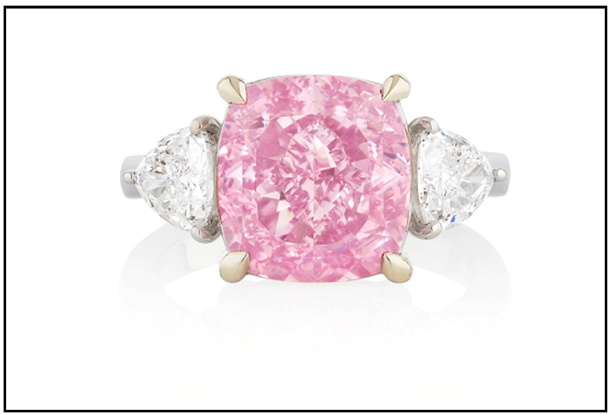
The Williamson Pink Star is mounted in an 18k gold ring flanked by diamonds
The Williamson Pink Star is mounted in an 18k gold ring flanked by trapeze

“Not every rough can yield a diamond of this high quality so we should also give credit to Diacore,” he says. “They really made cutting and polishing into an art. They are very skilled and experienced with the best technology and a lot of courage. It’s rare to have a vivid pink color. It’s rarer when it’s over 10 carats and even more rare if it’s internally flawless. It’s luck to find this kind of diamond that was formed underground for millions of years, and it takes a great amount of art and creativity to fashion it into a gorgeous stone with so many exceptional qualities.”

Pink diamonds are among the rarest colors to occur naturally in diamonds. Of all the diamonds submitted to the Gemological Institute of America (which analyzes and grades diamonds), fewer than 3% are classified as colored diamonds, and fewer than 5% of those are considered predominantly pink.

The Argyle Mine in Australia, before it was retired in 2020 after exhausting its supply of gem-quality diamonds, produced more than 90% of the world’s pink diamonds. The absence of pink diamonds from this mine makes important pink diamonds like the one being offered even more rare, Yu says.

“Pink diamonds are still growing in demand in the market, and this now makes the Williamson Pink Star even more sought after,” he says.

The diamond is being presented in an 18k gold ring flanked by trapeze-cut diamonds and embellished with brilliant-cut diamonds.

London is the first stop where the diamond will be viewed by the public. It will then travel to Dubai, Singapore and Taipei before the final viewing and sale in Hong Kong.

Source: Anthony DeMarco forbes.com