
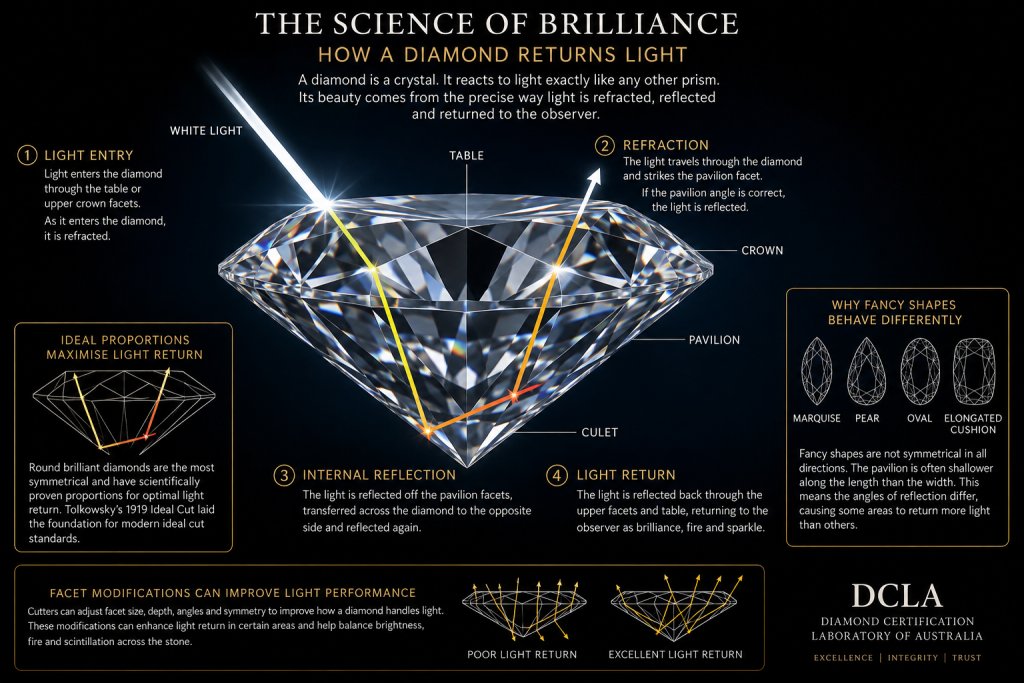
A diamond is far more than a beautiful gemstone. It is a precisely engineered optical crystal, and the way it interacts with light is governed by the same fundamental principles that apply to a prism.
When light enters a diamond through one of its facets, it does not simply travel straight through the stone. As it passes from air into diamond, the change in optical density causes the light to refract, or change direction. From there, the internal angles of the diamond determine whether that light continues through the stone, escapes, or is reflected back through the diamond.
This interaction between refraction, reflection and facet geometry is fundamental to a diamond’s brightness, fire and overall visual performance.
The Critical Role of Diamond Angles
The angles within a diamond are critical because light must follow a carefully controlled path through the stone.
When light enters through the table or upper crown facets, it is refracted as it enters the diamond. The light then travels towards the pavilion, the lower portion of the stone. If the pavilion angle is appropriate, the light strikes the pavilion facet at an angle that allows it to be reflected rather than immediately escaping through the bottom of the diamond.
The reflected light is then redirected across the stone towards another pavilion facet, where it can be reflected again. From there, it travels back towards the crown and eventually exits through the upper facets and table, returning light towards the observer.
This process is commonly referred to as light return.
In simple terms, the diamond is acting as a sophisticated optical system. The facets are the surfaces that control the direction of the light, while the angles determine whether the light is retained, reflected and ultimately returned to the viewer.
Refraction and Reflection Working Together
Two optical principles are particularly important.
Refraction occurs when light changes direction as it passes from one material into another, such as from air into diamond.
Reflection occurs when light strikes an internal surface and is redirected rather than passing through it.
The relationship between these two principles is what gives a well-cut diamond its characteristic brightness.
The pavilion is particularly important. If the pavilion is too shallow, light can escape through the bottom of the stone rather than being reflected back towards the crown. If it is too deep, light can also be directed away from the viewer.
The objective is therefore not simply to make a diamond deeper or shallower. The pavilion, crown, table and other facets must work together within appropriate proportional relationships.
Why Proportions Matter
A diamond can contain excellent material and still appear dull if it has been cut with proportions that do not manage light effectively.
A well-proportioned diamond allows a significant amount of the light entering through the crown to be redirected back towards the observer.
This is one of the reasons round brilliant diamonds have become so highly developed from an optical and scientific perspective. Their high degree of symmetry makes it possible to study and define their proportions with considerable precision.
The round brilliant is generally regarded as the most symmetrical of the major diamond shapes, allowing established proportion systems and ideal-cut concepts to be applied more consistently.
One of the historic milestones in the development of ideal-cut theory was Tolkowsky’s 1919 Ideal Cut, developed by Marcel Tolkowsky. His work examined the mathematical relationship between a diamond’s proportions and its ability to return light, helping establish the foundations for modern diamond-cut analysis.
Why Fancy-Cut Diamonds Behave Differently
Fancy shapes introduce a much more complicated optical challenge.
Unlike the round brilliant, many fancy shapes are not symmetrical in all directions. This includes elongated oval, marquise, pear and elongated cushion-cut diamonds.
The length and width of these diamonds can have significantly different proportions. Consequently, the pavilion geometry along the length of the diamond may not behave in exactly the same way as the pavilion geometry across its width.
This can produce differences in light return across different areas of the stone.
For example, an elongated oval may have one optical response along its length and another across its width. The same principle can apply to marquise and pear shapes, where the geometry changes considerably from the centre towards the points.
This is one reason why two diamonds of the same shape, carat weight and colour can look noticeably different when viewed side by side.
The Pavilion Is the Engine Room of Light Return
When examining diamond performance, the pavilion deserves particular attention.
The pavilion facets are responsible for much of the internal reflection that sends light back towards the crown. Their angles determine the path that light takes once it has entered the stone.
In an elongated diamond, achieving consistent light return across the entire stone can be particularly challenging. The cutter must balance the pavilion angles, crown facets, table and overall depth to manage light across different sections of the diamond.
A change in one area can influence another.
This is why diamond cutting is both an art and a science. The cutter is not simply removing material to create a particular outline. They are creating a three-dimensional optical structure in which thousands of possible light paths interact.
Facet Modifications Can Influence Light Return
Modern cutting techniques allow cutters to modify facet arrangements and proportions to improve the visual performance of a diamond.
Changes to facet size, placement, depth and symmetry can influence the way light travels through the stone. In some designs, modifications can help compensate for the optical challenges created by an elongated or unusual shape.
A cutter may adjust the geometry of the stone so that particular areas interact with light more effectively. However, these modifications always involve compromises. Improving light performance in one area can potentially affect another.
The goal is therefore to find the best balance between shape, proportions, symmetry, weight retention and optical performance.
Why Two Diamonds Can Look Completely Different
This explains why carat weight alone is never enough to judge a diamond.
Two diamonds can both weigh one carat, have the same colour and clarity grades, and yet appear very different when placed next to each other.
One may look bright and lively, while the other may appear darker or have areas where light escapes.
The difference can be found in the way each stone has been cut.
The combination of table size, crown angle, pavilion angle, total depth, girdle proportions, facet arrangement and symmetry determines how the diamond interacts with incoming light.
For fancy shapes, the challenge becomes even greater because the optical behaviour can vary across the stone.
Looking Beyond the Sparkle
When you look at a diamond and see flashes of white light, coloured fire and areas of brightness and contrast, you are seeing the result of physics occurring inside the crystal.
The diamond has not simply been polished to look attractive. Its facets have been arranged to control light.
Understanding this is important for both consumers and professionals. A diamond should be evaluated not only by its carat weight, colour and clarity, but also by the quality of its cut and the way its proportions and facets work together.
At the Diamond Certification Laboratory of Australia (DCLA), understanding the relationship between a diamond’s proportions, symmetry and optical behaviour is an important part of professional diamond assessment.
The next time you look into a well-cut diamond, remember what is happening beneath the surface: light enters, changes direction, travels through carefully calculated angles, reflects from pavilion facets and is redirected back towards you.
That journey of light is what creates the life and brilliance we see in a diamond.
Comments are closed