
Historic Fabergé Egg Encrusted with Diamonds Sets New World Record

A rare imperial Fabergé masterpiece

A rare imperial Fabergé masterpiece lavishly adorned with platinum and 4,500 diamonds has achieved a remarkable £22.9 million at auction in London, establishing a new world record for any Fabergé artwork.

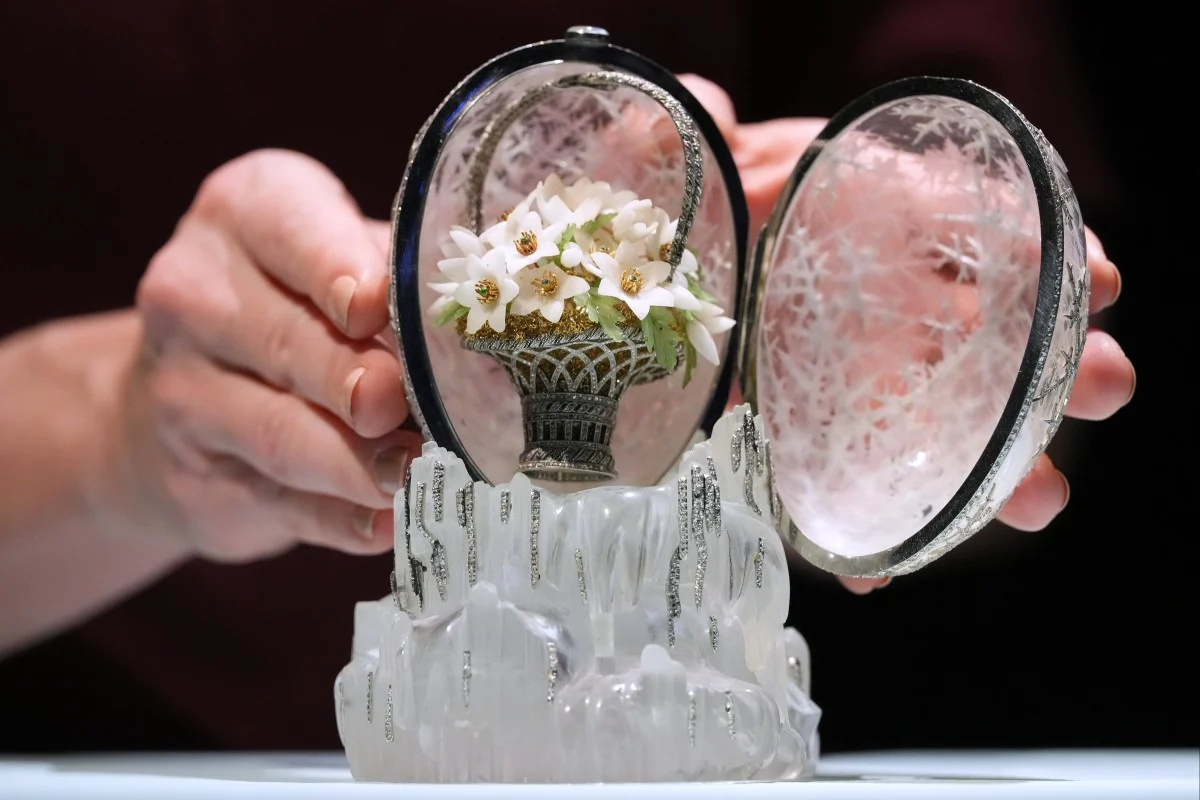
The famed Winter Egg was commissioned in 1913 by Emperor Nicholas II of Russia as an Easter gift for his mother, Dowager Empress Maria Feodorovna. Considered one of the most spectacular creations by the House of Fabergé, the piece showcases masterful artistry: a flawless rock crystal shell, intricately engraved to resemble winter frost, embellished with a delicate snowflake motif and shimmering diamonds.

Christie’s confirmed that the £22,895,000 sale price surpasses the previous Fabergé auction record by more than £13 million a benchmark also set by Christie’s in 2007 with the sale of the Rothschild Egg for £8.9 million. Remarkably, this is the third time the Winter Egg has broken the world record for a Fabergé creation.

“Today’s result reaffirms the enduring significance of this masterpiece, celebrating the rarity and brilliance of what is widely regarded as one of Fabergé’s finest creations,”
said Margo Oganesian, Christie’s Head of Fabergé & Russian Works of Art.

Only a limited number of Imperial Eggs remain in private ownership, making this sale a landmark moment for collectors and institutions worldwide.

A Tumultuous Century of Provenance

Following the fall of the Russian monarchy in 1917, the Winter Egg was moved to the Kremlin Armoury and later included in Soviet sales of royal treasures during the 1920s.

Over its journey through history:

Purchased by Wartski of London in the early 20th century for just £450

Sold privately in 1934 for £1,500

Considered lost between 1975–1994

Re-emerged at Christie’s in 1994, achieving a record 7,263,500 Swiss francs (£6.8 million)

Set a new record once more in 2002 at $9,579,000 (£7.1 million)

Today’s sale firmly cements its status as one of the most coveted objets d’art ever created.

Celebrating Excellence in Diamond Craftsmanship

With its extraordinary diamond detail and technical precision, the Winter Egg continues to define the pinnacle of artisanal luxury. Each stone carefully set into platinum reflects the superior craftsmanship that has made Fabergé synonymous with imperial elegance.

For DCLA, iconic pieces such as this highlight the enduring importance of diamond quality, authentication, and expert certification ensuring that history and value are preserved for future generations.

Fabergé’s Legendary Winter Egg Expected to Shatter Records with $27 Million Estimate

The 1913 Winter Egg with its hidden floral surprise.

A rare Fabergé masterpiece — the Winter Egg, crafted in 1913 from rock crystal and adorned with 1,660 diamonds — is set to reclaim its world record with an estimated sale price exceeding $27 million when it goes under the hammer at Christie’s London on 2 December.

Commissioned by Tsar Nicholas II as an Easter gift for his mother, the Dowager Empress Maria Feodorovna, the exquisite egg was designed by Alma Theresia Pihl, one of only two female artists to ever design for the House of Fabergé.

Standing four inches tall, the Winter Egg opens to reveal a platinum trelliswork basket of carved quartz flowers, each delicately set with rose-cut diamonds and demantoid garnet centres, resting on a base of gold moss. The egg itself sits upon a rock-crystal plinth shaped like melting ice, symbolising the transition from winter to spring — a theme often celebrated in Fabergé’s Imperial creations.

The piece will be the centrepiece of The Winter Egg and Important Works by Fabergé from a Princely Collection sale. Christie’s confirmed the estimate is “in excess of £20 million” (US$26.9 million).

The Winter Egg has twice held the world record for a Fabergé piece sold at auction — fetching $9.1 million in Geneva in 1994 and $9.6 million in New York in 2002. The current record holder, the Rothschild Egg, achieved $11.9 million at Christie’s London in 2007, a benchmark the Winter Egg is now poised to surpass.

Between 1885 and 1916, the House of Fabergé produced 50 Imperial Easter Eggs, with 43 known to survive today. Most reside in museum collections, while only seven, including the Winter Egg, remain in private hands — making this sale a landmark moment for collectors and historians alike.