
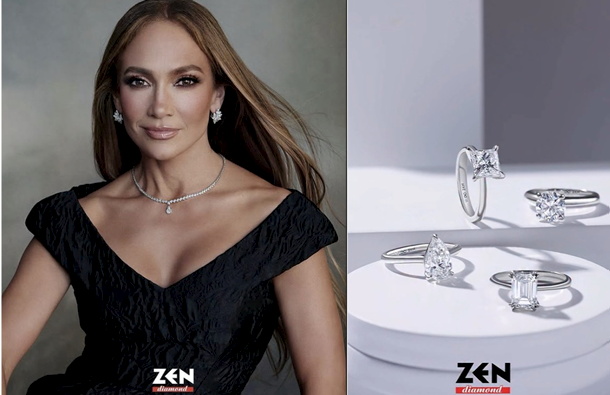
J.Lo, Four-Times Divorced, Promotes Engagement Rings

Jennifer Lopez

Jennifer Lopez, who has been married and divorced four times, is advertising diamond engagement rings for Turkish manufacturer Zen Diamond.

The 56-year-old actress and singer is being $10m for the promotion, which also includes necklaces, earrings and other items, according to the New York Post’s Page Six gossip column.

That’s hardly a life-changer for J.Lo, an astute businesswoman who has amassed a fortune estimated at $400m (and who is used to far bigger paychecks).

She also has an enviable collection of engagement rings, six in all. She married Cuban model Ojani Noa (1997-8); dancer and choreographer Cris Judd (2001-3); singer/songwriter Marc Anthony (2004-14) and Ben Affleck (2022-4).

She received additional engagement rings from husband number four Ben Affleck, who first proposed in 2002, and from former New York Yankees star Alex Rodriguez in 2019.

Zen Diamond’s advertising campaign featuring Jennifer Lopez launched in early November, primarily on Instagram and YouTube, as well as the brand’s official websites and international news outlets.

Company chairman Emil Guzelis said: “Her energy and charisma perfectly reflect Zen’s vision and the spirit of our jewelry. This collaboration represents a new chapter in our brand’s international growth story.”

Zen Diamond and traces it roots back to 1906. It has wholesale branches in New York, Antwerp, and Dubai, 175 stores worldwide and 850 staff working in Istanbul at what it describes as “Europe’s largest diamond jewelry production facility”.

Source: IDEX

The Four Ex Diamond

diamond pendant


Sourcing a diamond is easy with the help and guidance of the DCLA diamond exchange.

Proportion is graded alongside Symmetry, polish and importantly the Transparency.

This is why the Diamond Exchange are the most sought after for those who want the finest diamonds available.

To ensure the highest quality, the Diamond Exchange works with the finest rough diamond producers based in South Africa, Antwerp, Israel and India.

Each diamond is then meticulously analysed by our Laboratory diamond gemologists.

Using sophisticated laboratory equipment every aspect of the individual stone is checked, including the all-important proportions that will produce the most brilliance.

Proportions

Proportions affect how light travels within the diamond.

Diamonds that are cut too shallow and wide, or too deep and narrow lose light out the sides or bottom, causing the diamond to lose brilliance.

A select Diamond exchange Diamond are cut to ideal diamond proportions, creating a superior diamond to reflecting the maximum amount of light back to the eye.

Symmetry

The alignment of a diamond’s facets in relation to each other or opposing facets affects the diamond’s light performance.

Facets which are symmetrical and aligned, reflect light directly back to your eye.

Symmetry grading to Hearts and Arrows standards ensure its brilliance and fire is emitted evenly.

Certification

All Diamond Exchange diamonds are certified by recognised international accredited laboratories.

This provides you an authoritative analysis of your diamond.

Diamond Exchange also verifies that your diamond meets all the specific quality requirements and checks the diamond is cold laser inscribed.

Transparency

Transparency, also called pellucidity, is the material property of allowing light to pass through. In mineralogy, another term for this property is diaphaneity.

Developed by the DCLA , the Transparency Grade is the degree to which a diamond transmits light, directly relevant to its ‘cloudiness’ or ‘haziness.

In other words, it is a comprehensive assessment of light performance based on the quality of the diamond crystal itself.

Diamond Prices Firm After Supply Declines

Polished diamonds

Diamond trading was seasonally slow in December as the industry’s focus shifted to retail and as diamantaires took their end-of-year break. Sentiment received a boost from strong holiday e-commerce sales, the distribution of Covid-19 vaccines, and the US approval of a $900 billion coronavirus stimulus package.

Polished prices firmed as supply declined due to limitations on diamond manufacturing during India’s lockdowns. The RapNet Diamond Index (RAPI™) for 1-carat diamonds rose 2.3% in December and 5.8% for the full year.

RapNet Diamond Index (RAPI™)
December4Q 2020FY 2020
RAPI 0.30 ct.0.4%-4.7%0.2%
RAPI 0.50 ct.0.8%-2.3%12.1%
RAPI 1 ct.2.3%3.8%5.8%
RAPI 3 ct.2.5%7.0%3.7%

© Copyright 2021, Rapaport USA Inc.

The industry began 2021 with a healthier supply-demand balance than it had at any stage in the past five years.

The volume of 1-carat diamonds on RapNet in the D-H, IF-VS range — the categories the RAPI measures — declined 24% in the second half of 2020. The top 10% of diamonds in that category were selling at an average of 32% below the Rapaport Price List on January 1, 2021, compared to 37% below on July 1, 2020. The lower discount suggests that demand is stronger relative to the available supply.

Manufacturers are raising polished production in anticipation of steady first-quarter orders as jewelers and dealers seek to replace inventory they’ve sold during the holiday period.

Jewelers with solid e-commerce programs had a good season. Many off-mall independents also did well, as consumers felt safer visiting stand-alone stores than crowded malls and were driven to support local community businesses following the Covid-19 lockdowns. Independents without an effective online presence struggled.

US jewelry sales for October 11 to December 24 fell 4.3% year on year, according to Mastercard SpendingPulse. Online jewelry sales grew 45%.

There is some optimism for the year ahead even as Covid-19 continues to disrupt business activity. To ensure growth, the trade must intensify its efforts to engage with consumers via storytelling and improved omni-channel platforms while keeping supply in sync with prevailing levels of demand.

Source: Diamonds.net

More Brides Buying Their Own Engagement Rings

De Beers insight report

US women increasingly buy engagement rings for themselves, and spend more on them than their partners do, De Beers said Monday in its annual Diamond Insight Report.

The proportion of engagement rings financed solely by brides rose to 14% in 2017 from 11% in 2015 and 7% in 2013, according to the report. The trend reflects growth in female purchasing power, one of several social changes impacting the segment De Beers refers to as “commitment jewelry.”

During the four years ending 2017, grooms’ average outlay on engagement rings dropped 13%, while brides’ spending rose 19%, De Beers noted. In 2017, brides who reported buying the ring themselves shelled out an average of $4,400, while grooms spent $3,300, the company said.

“This emphasizes that growing purchasing power among women is a factor to be reckoned with in the commitment space, and not only when it comes to self-purchasing of diamond jewelry,” the company noted.

The 2019 Insight Report focuses on how consumers view love and diamonds amid changing attitudes to relationships. While marriages rates have declined in the US and engaged couples are waiting longer to tie the knot, “love remains a constant,” and consumers are buying diamonds in a wider variety of ways to symbolize it, De Beers explained.

Commitment jewelry — diamond engagement rings, and diamond wedding bands or rings for women — has retained its important place in the market, with just over 70% of US brides acquiring a diamond engagement ring.

However, the global value of men’s gifts of diamond jewelry to women before or after a wedding now exceeds the value of the engagement- and wedding-ring market. Women in the US who cohabit with their partners now account for 10% of the female diamond-jewelry market. Meanwhile, more than 70% of people in same-sex relationships view diamonds as important for celebrating life’s special events, the report continued.

Those four trends — commitment jewelry, “love gifting,” cohabitation and same-sex couples — are the focus of this year’s edition of the De Beers research. Consumers are still attracted to diamonds as an emblem of love, but are approaching the product in new ways that mirror those contemporary modes of living, the company argued.

“While diamonds are still seen as the ultimate symbols of love, the diamond industry must focus on continuing to offer jewelry, brands and retail experiences that meet the modern consumer’s desire for individual products and experiences that reflect their own unique love story,” said De Beers CEO Bruce Cleaver.

Source: Diamonds.net