
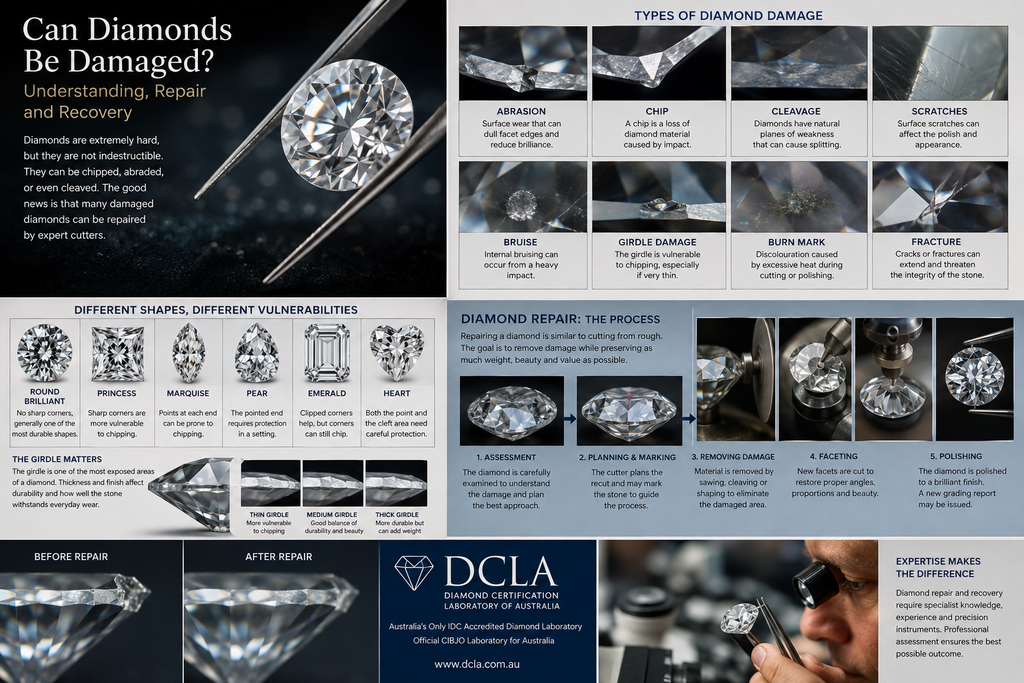
Diamonds are famous for being exceptionally hard. In fact, diamond ranks 10 on the Mohs scale of hardness, making it highly resistant to scratching.
But there is an important distinction between hardness and toughness.
A diamond can resist being scratched while still being capable of chipping, fracturing, cleaving or breaking if it receives the wrong type of impact. As DCLA explains, diamonds are among the hardest materials on Earth, but they are not indestructible. Their crystal structure contains planes of weakness, and the way a diamond is cut can also influence how vulnerable particular areas are to damage.
So, can a damaged diamond be repaired?
In many cases, yes. The solution may involve anything from a light repolish to a significant recut. The objective is generally to remove the damaged material while retaining as much of the diamond’s weight, appearance and value as possible.
What Can Damage a Diamond?
Diamond damage generally falls into several categories. Some damage is caused by everyday wear, while other damage can occur through an accidental impact, during jewellery manufacture or even during the cutting and polishing process.
The most common problems include:
- Abrasion
- Chips and nicks
- Scratches and polish lines
- Cleavage
- Fractures and cracks
- Bruising
- Damage to the girdle
- Burn marks or polishing burns
These conditions should not automatically be confused with clarity characteristics. A natural inclusion formed inside a diamond is fundamentally different from damage that occurs to the diamond after it has been cut.
DCLA’s Glossary & Picture Library provides explanations and images of many of these diamond characteristics.
Abrasion: When the Diamond’s Surface Becomes Worn
An abrasion occurs when the surface or facet edges of a diamond become worn through contact with other materials.
Over time, a diamond that is worn every day can develop small areas of wear, particularly around the facet junctions, girdle and culet. DCLA notes that facet edges can become rounded or dulled, reducing the crispness of the diamond’s finish.
Abrasions may be difficult to see with the naked eye but can become obvious under 10× magnification.
Why does this matter?
A diamond’s brilliance depends upon accurately polished and precisely angled facets. If the edges and surfaces become worn, light can interact differently with the stone and the diamond may appear less sharp and lively.
Minor abrasion does not necessarily mean a diamond has suffered serious structural damage. In many cases, a cutter can remove the affected area through repolishing.
Chips: A More Serious Form of Damage
A chip is an actual loss of diamond material.
It can occur when the diamond receives a sharp impact, particularly around an exposed edge, corner or point. The damage can range from a tiny nick to a significant portion of a facet or girdle being broken away.
The location of the chip is extremely important.
A small chip in an inconspicuous area may be relatively straightforward to remove through polishing. A chip that extends deeper into the stone, approaches an inclusion or follows a cleavage direction can present a much greater challenge.
DCLA’s glossary specifically identifies chips as one of the characteristics that can occur when a diamond sustains damage.
DCLA Glossary & Picture Library – Chip
Cleavage: The Natural Weakness Within a Diamond
One of the most important things to understand about diamond damage is cleavage.
Diamonds have a crystalline structure containing natural planes of weakness. If a diamond is struck with sufficient force in the wrong direction, it can fracture or split along one of these planes.
This is known as cleavage.
This is one reason professional diamond cutters must understand the internal structure of a rough diamond before deciding how to cut it.
The same principle applies when repairing a damaged stone.
A cutter cannot simply look at the chip and start removing material. They must consider the direction of the damage, the diamond’s internal characteristics, its proportions, the location of inclusions and the final shape that can be achieved.
Burn Marks: Can a Diamond Actually Be Burnt?
Yes, diamonds can show burn marks, particularly as a result of excessive heat generated during cutting or polishing.
DCLA describes burn marks as discolouration or hazy areas associated with excessive heat or pressure during the cutting and polishing process. Depending on the severity, the affected area may sometimes be removed through polishing or may require more extensive recutting.
A burn mark should therefore not automatically be interpreted as evidence that somebody has literally held a flame to a diamond.
Diamond cutting and polishing generate considerable heat. Professional cutters carefully control the process because excessive heat can affect the polished surface.
Why Some Diamond Shapes Are More Vulnerable Than Others
The shape of a diamond can have a significant effect on its vulnerability to accidental damage.
The reason is simple: sharp corners and thin edges provide less protection against impact than rounded surfaces.
DCLA’s information on diamond durability and girdle thickness highlights the importance of shape, girdle thickness and the way the diamond is mounted.
Round Brilliant
The round brilliant is generally one of the more durable diamond shapes because it has no sharp corners.
Its continuous rounded outline means there are fewer obvious points at which an impact can concentrate.
This does not make a round diamond impossible to damage, but its shape generally provides good protection against corner chipping.
Princess Cut
Princess cuts have four sharp corners.
Those corners can be particularly vulnerable to chips if they are exposed to a hard impact or if the stone has been cut with insufficient protection around the corners.
DCLA specifically identifies princess-cut diamonds as being more susceptible to damage around their sharp corners.
Marquise
The marquise has two pointed ends.
Those points can be vulnerable to chipping, particularly if the girdle is thin or the setting does not adequately protect them.
Pear Shape
A pear-shaped diamond combines a rounded end with a pointed end.
The point is particularly important because it represents an area where an impact can cause damage.
A well-designed setting normally provides protection around this vulnerable area.
Heart Shape
A heart-shaped diamond has both a pointed bottom and a distinctive cleft at the top.
Both areas require careful consideration when cutting, setting and wearing the diamond.
Emerald Cut
The emerald cut has large step facets and clipped corners rather than the sharp 90-degree corners of a traditional princess cut.
The corners are still potential points of damage, however, and the large, open facets can make surface characteristics and damage easier to see.
Radiant Cut
Radiant diamonds have clipped corners, which provide more protection than completely sharp corners.
Nevertheless, the corners and girdle still need to be considered when assessing durability.
Oval and Cushion
Both have predominantly rounded outlines and generally avoid the exposed sharp corners found in princess cuts.
However, the condition of the girdle and the presence of internal fractures or inclusions still matter.
The Girdle: One of the Most Important Areas to Protect
The girdle is the outer edge of a diamond, separating the crown from the pavilion.
It is also one of the areas most exposed to accidental damage.
A girdle that is extremely thin can be more vulnerable to chipping, particularly on fancy shapes with points or corners. DCLA explains that girdle thickness plays an important role in durability as well as the diamond’s overall proportions.
This is why a diamond’s girdle should always be considered when assessing a stone for everyday wear.
The jewellery setting also makes a difference.
Prongs can protect vulnerable areas, while a bezel setting can provide substantial protection around the diamond’s perimeter.
Can a Damaged Diamond Be Repaired?
This is where diamond cutting expertise becomes extremely important.
A damaged diamond is not repaired in the same way that a piece of metal might be repaired.
A cutter generally does not add material back to the diamond.
Instead, the damaged material is removed.
This can involve:
1. Repolishing
If the damage is extremely minor, the cutter may be able to remove it by polishing the affected facet or area.
Only a very small amount of diamond may need to be removed.
The objective is to restore a smooth, highly polished surface while preserving the existing proportions and as much carat weight as possible.
2. Recutting a Facet
If a chip affects the edge of a facet, the cutter may alter the facet slightly and polish away the damaged area.
This can sometimes be achieved with relatively little weight loss.
However, changing one facet can affect the relationship between other facets, so the cutter must consider the overall optical performance of the stone.
3. Recutting the Girdle
If damage is concentrated around the girdle, the cutter may be able to repolish or reshape the girdle.
A damaged girdle can sometimes be transformed into a cleaner polished or faceted girdle.
DCLA’s glossary explains that girdles may have different finishes, including polished, faceted and bruted finishes.
4. Removing a Larger Chip
If a chip is too large to polish away without leaving an obvious defect, the diamond may need to be recut.
This is much more similar to the original manufacturing process used to transform rough diamond into a polished diamond.
The cutter determines where material must be removed, establishes new proportions and creates new facets before polishing them.
The result may be a smaller diamond, but one that is significantly more attractive and potentially more valuable than the damaged stone.
Repairing a Diamond Is Similar to Cutting a Diamond From Rough
This is perhaps the most fascinating part of diamond repair.
The principles used to salvage a damaged diamond are closely related to the principles used when transforming rough diamond into a finished gemstone.
When a cutter receives a rough diamond, they must decide:
Where should the diamond be cut?
They consider the crystal shape, inclusions, cleavage directions, potential yield, proportions and the final shape that will produce the best combination of beauty and value.
The same thinking applies when repairing a damaged diamond.
The cutter asks:
Where can the damage be removed while retaining the maximum possible value?
The stone may first be examined under magnification and measured. The cutter then considers the damage and models or plans the proposed recut.
The cutting process can involve:
Planning → Marking → Sawing or Cleaving → Blocking → Bruting/Shaping → Faceting → Polishing
Not every repair requires every one of these stages.
A tiny chip may require only repolishing.
A badly damaged diamond may require a much more substantial recut.
DCLA’s diamond grading and technology information explains that cutting and polishing require specialised techniques and that finished diamonds are assessed for proportions, polish and symmetry.
The Price of Repair: Carat Weight Versus Value
One of the biggest questions owners ask is:
“How much weight will I lose?”
There is no universal answer.
It depends entirely on the location and severity of the damage and what the cutter needs to do to remove it.
Sometimes only a fraction of a carat is lost.
In other cases, a significant recut may be necessary.
But the objective should not simply be to preserve the highest possible carat weight.
A damaged 1.00-carat diamond with a major chip may be less desirable than a beautifully recut 0.90-carat diamond.
The cutter’s objective is to find the best balance between:
- Carat weight
- Shape
- Proportions
- Symmetry
- Polish
- Brilliance
- Durability
- Market value
This is why a professional damage assessment and recut analysis should be carried out before deciding what to do with a damaged diamond.
What Happens to the Diamond Certificate After a Recut?
This is an important consideration that is sometimes overlooked.
A significant recut can change the diamond’s:
- Measurements
- Carat weight
- Proportions
- Symmetry
- Polish
- Shape
Consequently, an existing grading report may no longer accurately describe the stone.
The diamond may therefore need to be regraded and reissued with a new report after substantial work.
The original report should be retained as part of the diamond’s history, particularly for insurance and provenance purposes.
DCLA reports document characteristics including carat weight, colour, clarity, measurements, cut, polish, symmetry, fluorescence and other identifying characteristics.
Don’t Assume a Damaged Diamond Is Worthless
One of the biggest mistakes an owner can make is seeing a chipped or damaged diamond and immediately assuming it has lost most of its value.
That is not necessarily the case.
A damaged diamond can often be salvaged.
DCLA provides specialist damage assessment and diamond recovery services specifically for this purpose. The diamond can be examined to determine whether repolishing, recutting or another approach offers the best recovery.
DCLA Diamond Salvage Assessment & Recovery Services
The important question is not simply:
“Is my diamond damaged?”
It is:
“What is the best way to recover the maximum possible beauty, durability and value from the diamond?”
That requires experience.
Prevention Is Better Than Repair
Although diamonds are extraordinarily hard, they should still be treated with care.
Avoid wearing valuable diamond jewellery during activities where the stone could receive a heavy impact. Pay particular attention to engagement rings and other jewellery containing diamonds with exposed points or corners.
Regular professional inspection can also identify loose settings, damaged prongs, thin girdles or early signs of wear before a major problem occurs.
And remember: hard does not mean indestructible.
A diamond can survive for generations, but the combination of its crystal structure, internal characteristics, cut, shape, girdle thickness and jewellery setting all influence its durability.
The DCLA View: Damage Does Not Necessarily Mean the End of the Diamond
Diamonds are extraordinary natural crystals, but they are not immune to damage.
Abrasion can wear the surface.
A sharp impact can create a chip.
A serious blow can cause cleavage or fracture.
Excessive heat during polishing can create a burn mark.
And sharp corners or very thin girdles can make certain diamond shapes more vulnerable.
The good news is that many damaged diamonds can be repaired or salvaged.
The process may be as simple as repolishing a small damaged area or as sophisticated as completely recutting the diamond. In either case, the principles are remarkably similar to those used when transforming rough diamond into a finished gemstone: understand the crystal, identify the weaknesses, plan the cut and remove only the material necessary to achieve the best possible result.
At DCLA, our experienced diamond professionals can assess damaged stones and determine whether repolishing, recutting or another recovery option is appropriate.
Before writing off a damaged diamond, have it professionally assessed. You may be surprised by how much of its beauty and value can be recovered.
Explore the DCLA Diamond Glossary
DCLA’s online Glossary & Picture Library provides educational information on diamond characteristics and terminology, including chips, cleavage, clarity, girdles and other features.
You can also explore DCLA’s dedicated pages on Abrasion, Cleavage, Girdle, Girdle Thickness, Burn Marks and Polish Grade.
Comments are closed