
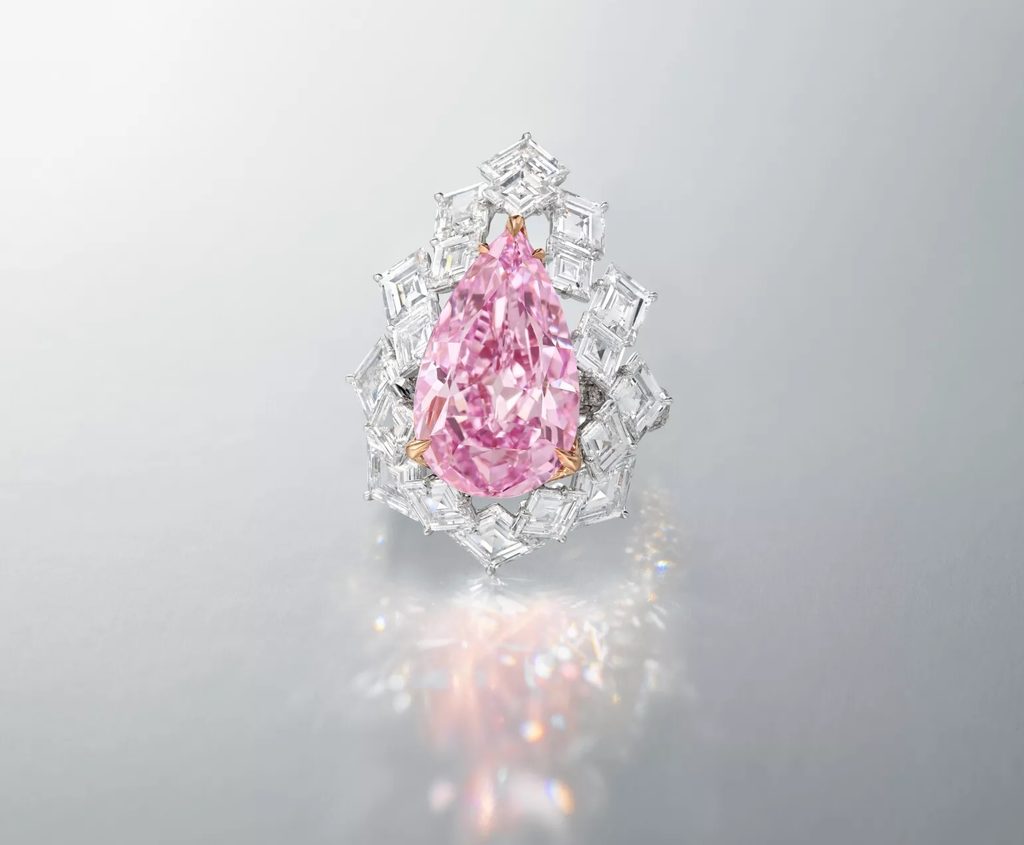
Few gemstones command the combination of fascination, rarity and value associated with a natural pink diamond.
Unlike many coloured gemstones, the extraordinary pink colour of a natural diamond is not simply the result of a trace element creating a familiar colour. The science behind natural pink diamonds is considerably more complex. Their colour is generally associated with structural distortion within the diamond’s crystal lattice, created deep within the Earth over immense periods of geological time.
It is this extraordinary combination of natural rarity, geological history and optical beauty that has placed the finest pink diamonds among the world’s most coveted gemstones.
Now, Christie’s is preparing to offer another remarkable example.
At its Hong Kong Magnificent Jewels Autumn Auction on November 24, Christie’s will present an 8.41-carat pear modified brilliant-cut Fancy Vivid Purple-Pink diamond, with an estimate reaching HKD 95 million, approximately US$12 million.
The stone is also classified as Type IIa, adding another notable dimension to its gemmological profile.
When colour becomes the rarity
In the world of diamonds, carat weight is only one part of the story.
For exceptional coloured diamonds, hue, tone, saturation and distribution of colour can be every bit as important as size. A diamond may be large, yet its colour characteristics can determine whether it becomes merely unusual or genuinely extraordinary.
The Christie’s diamond combines several characteristics rarely encountered together: significant size, a strong purple-pink colour, Fancy Vivid intensity and Type IIa classification.
The result is a gemstone occupying an exceptionally rare position within the natural diamond market.
The distinction between a pink diamond and an exceptional pink diamond can be subtle to the untrained eye. Under professional examination, however, the precise characteristics of colour become a sophisticated subject of gemmological analysis.
The science behind natural pink
The colour of most natural diamonds is associated with impurities within the crystal structure. Nitrogen, for example, plays a major role in many yellow diamonds.
Pink diamonds are different.
Their colour is generally linked to deformation of the diamond’s atomic lattice, rather than simply the presence of a colouring impurity. Scientists believe that immense geological forces can distort the crystal structure during the diamond’s formation and subsequent journey toward the Earth’s surface.
This distortion affects the way light interacts with the diamond, producing the extraordinary pink appearance for which these stones are renowned.
The exact relationship between crystal deformation and the resulting colour remains an area of sophisticated scientific study, making pink diamonds particularly fascinating from both a gemmological and geological perspective.
Type IIa: exceptional chemical purity
The Christie’s diamond is classified as Type IIa, a designation that describes the diamond’s chemical composition.
Type IIa diamonds contain extremely low levels of detectable nitrogen and are regarded as among the chemically purest diamonds.
This classification should not, however, be confused with a quality grade.
Type IIa is a scientific classification, not a statement that a diamond is automatically more valuable. A diamond’s desirability and market value depend on the complete combination of its characteristics.
In this case, Type IIa adds another intriguing scientific feature to an already exceptional natural coloured diamond.
Why the strongest pinks are so difficult to find
The rarity of exceptional natural pink diamonds has been reinforced by the limited availability of significant sources of these stones.
For decades, Australia’s Argyle mine in Western Australia was internationally recognised as the world’s most important source of natural pink diamonds. The mine produced an extraordinary range of pink, red and purplish diamonds, but ceased production in 2020.
Its closure fundamentally changed the landscape for the supply of important natural pink diamonds.
While pink diamonds can occur in other deposits around the world, stones possessing the combination of strong colour, exceptional saturation, significant size and desirable clarity remain exceptionally uncommon.
This scarcity has helped establish the finest natural pink diamonds as important collector gemstones rather than simply luxury jewellery.
The auction market for exceptional colour
Major jewellery auctions provide a fascinating window into the upper end of the natural coloured diamond market.
When a rare stone comes to auction, collectors are not simply buying carat weight. They are competing for a combination of characteristics that may never be replicated.
The provenance of a jewel, its laboratory documentation, its natural colour, treatment status, cutting quality and historical significance can all contribute to its desirability.
For a gemstone of this calibre, laboratory examination is therefore fundamental.
A second extraordinary jewel
Christie’s Hong Kong sale will feature another remarkable gemstone in the form of a 10.10-carat Burmese ruby, set within a Cartier brooch incorporating triangular and square diamonds.
The jewel carries a high estimate of approximately HKD 60 million, or US$7.7 million.
The ruby is particularly significant for its Burmese origin and substantial size, while the Cartier design connects the jewel with the maison’s pioneering use of platinum during the early 20th century.
Exceptional Burmese rubies are among the world’s most celebrated coloured gemstones, particularly when they display desirable colour, transparency and other characteristics associated with fine-quality material.
The importance of knowing what lies beneath the beauty
At the highest levels of the jewellery market, beauty and science increasingly go hand in hand.
A spectacular diamond may capture the eye, but professional gemmology seeks to establish what the stone actually is, how its characteristics were formed and whether those characteristics are natural or treatment-related.
For coloured diamonds, this distinction can be particularly important.
Independent laboratory examination can investigate characteristics such as natural versus laboratory-grown origin, colour treatment, diamond type and other identifying features. For important stones, such documentation provides an objective scientific foundation for the jewel’s description.
At DCLA, the Diamond Certification Laboratory of Australia, gemmological examination is centred on independent scientific assessment and reporting in accordance with recognised international standards.
A jewel measured in rarity, not simply carats
The Christie’s 8.41-carat Fancy Vivid Purple-Pink diamond illustrates why exceptional gemstones occupy a category of their own.
Its significance lies not simply in its weight.
It is the combination of natural colour, vivid intensity, purple-pink hue, substantial size, Type IIa classification and exceptional geological rarity that makes the stone so compelling.
As it takes its place under the hammer in Hong Kong, collectors will once again be reminded of one of the enduring truths of the diamond world:
The rarest diamonds are not necessarily the largest. They are the diamonds in which nature has created something extraordinarily difficult to reproduce.
And in the case of a truly exceptional natural pink diamond, that rarity began billions of years before it ever became a jewel.
Comments are closed